I really don't get what is supposed to happen. The folks that can do something about this have no incentive to do so - instead, they're often incentivized to do something against it.
So what's the solution? Me recycling cans and using public transportation and going vegan and ... isn't going to solve this problem. The people who aren't already convinced aren't going to change their habits.
Pardon my french, but are we just completely and collectively fucked? What does a solution, long or short term, look like - realistically, not as per Musk et al?
It looks very simple. Public awareness and pressure will gradually change those incentives and emissions will be reduced significantly. At the same time people are going to adapt to the new environment as best they can and live on. If everything goes well, living standards around the world in a hundred years will be a lot higher than now.
Of course, this is not a given. A lot of people have to work very hard to get there. A lot of people have to change their minds or die, their opinions losing relevance. Alot of people will get unlucky or won't have the means to adapt to the new conditions, resulting in some of the worst humanitarian crises the world has ever seen. Conflict and war is a possibility that might work against this solution. There might be some big issues noone can think of now.
However unsexy this might sound, this is the solution and it will happen. The question is when and how much suffering it will take to get there.
The Hacker News consensus is that no one is doing anything. I used to believe this and despair. But that is _just not true_. I've subscribed to the Harvard C Change newsletter and it's really changed my perspective - past issues here: https://www.hsph.harvard.edu/c-change/climateoptimist/
Just one highlight: the current has administration canceled three fossil fuel lease sales in 2022 due to a lack of industry interest In contrast, there are currently 18 active offshore wind leases with 14 new site assessment plans approved, including the scoping of the first wind energy areas in the Gulf of Mexico and Gulf of Maine.[0]
It's not all sunshine and roses. But the narrative should be: 'some humans, albeit perhaps the minority, are fighting save this planet, and are winning at least of their battles'. Maybe it will be too little too late. But the narrative is decidedly not 'existential threat to our species and others, and no one gives a shit'.
If we would have done nothing, we'd have ended up with something like 6 degrees of warming. Instead we have a good hope of limiting it to 3 degrees. Still way too much, but way better than i expected 20 years ago. At this point 1.5 is hopeless, but 2 isn't, so let's make it our goal.
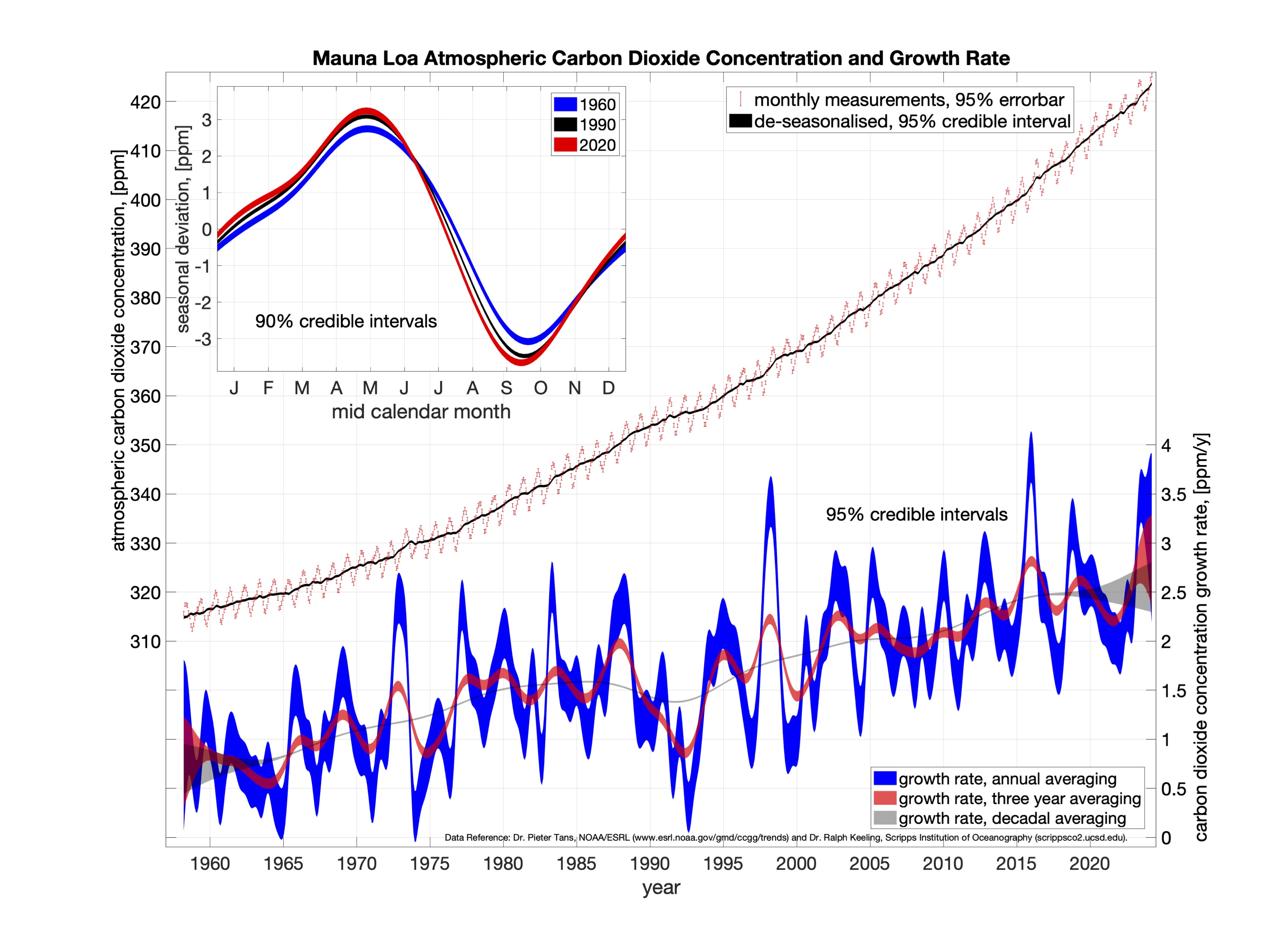
CO2 levels have continued on their long term trend since it started to be measured so no, there's really nothing that's been done and actual warming since the mid 70s is way way less than 6 degrees. All projections of such levels of warning were way off base.
10 years ago, not only were CO2 levels increasing every year, the second and third derivative were also positive. In other words the rate of increase was increasing, and so was the rate of increase of the rate of increase. That has changed.
It's like a huge train with tons of momentum hurtling towards a cliff. But every second we're not only pressing on the accelerator we're pushing harder on the accelerator. In other words, we were increasing the momentum of our foot on the accelerator. Over the last twenty years we've stopped pushing that accelerator harder and are just starting to very slightly ease up on the accelerator.
To avoid hitting the cliff we need to let off the accelerator and slam on the brakes. But at least our changes will have a significant impact on the speed we have when we hit the wall.
Anybody looking at the train from the side will be unable to notice tiny differences in rate of change of accelerator depth. But over time that increasing accelerator would have made things a lot worse.
Growth rate is very stable. You could almost put a ruler against the absolute line. As you say, people cannot really "notice tiny differences" on that scale.
Yes, I believe that both you and the graph agree with me.
The 1st derivative line of the CO2 levels is very noisy (as derivatives almost always are), but it seems to me that it shows a steady increase until it hit a peak in 2015 and now is decreasing. Hard enough to see in the derivative graph and completely impossible to see in the absolute CO2 level graph. So 2nd derivative of CO2 is now finally pointing in the right direction.
And the absolute CO2 level is approximately the first derivative of the temperature. So in other words we've only turned the 3rd derivative of temperature in the right direction. If it stays negative, over time that will eventually turn the 2nd and 1st derivatives. It's time we don't have if our goal is 1.5 degrees, but it's enough time to avoid 6 degrees. Where in the middle will we land?
Isn't that a repetition? Predictions based on assuming a perfectly understood relationship that led to 6 degree predictions, combined with no reduction in CO2 growth and yet a much less than 6 degree rise = way off base. What else would you call such a prediction?
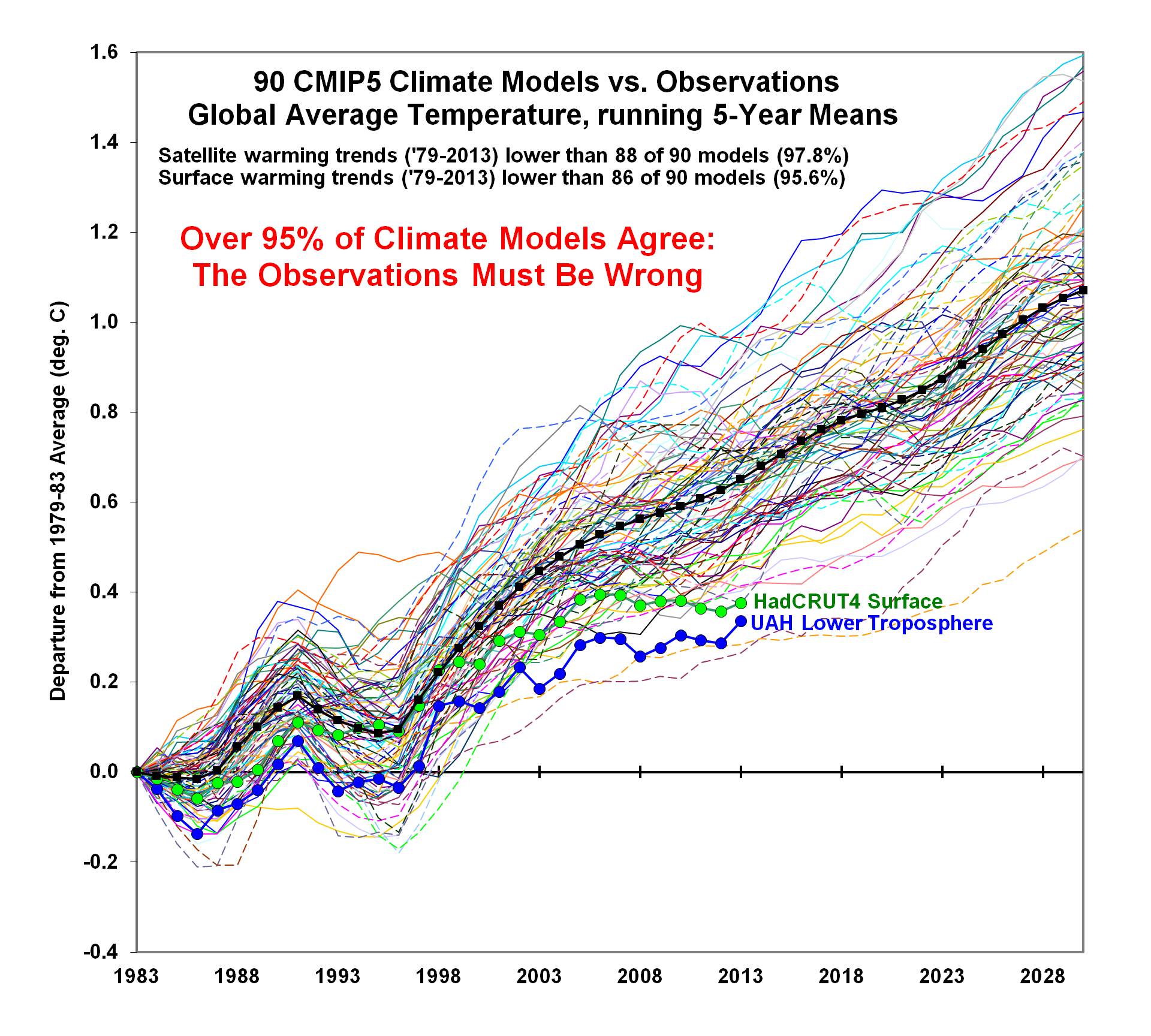
BTW I don't think many people were actually predicting 6 degrees so this is a bit academic. 6 degree rise sounds more like the IPCC's discredit "business as usual" RCP8.5 scenario. Most models predict a linear-ish trend of about 0.25C per decade, as you'd expect given their underlying premise that warming is all driven by CO2 and CO2 increases more or less linearly:
Edit: actually Hansen was predicting in 1988 a 6-7 degree rise by 2050 "if we do nothing", that's clearly not going to happen given that since then it's been about 0.5 degrees and CO2 levels have continued to climb inexorably.
≥ Predictions based on assuming a perfectly understood relationship that led to 6 degree predictions, combined with no reduction in CO2 growth and yet a much less than 6 degree rise = way off base
the predictions weren't based on a "perfectly understood relationship", but yeah, they're assuming we didn't do anything, and we did stuff, in order to reduce that number, and succeeded
> the predictions weren't based on a "perfectly understood relationship"
I pull this part out because it's key to so many of the disputes and is why climatology is such an incredibly divisive field compared to others. People who call themselves scientists should not be making high confidence predictions to the public or politicians when they don't perfectly understand the underlying relationships. They also shouldn't be making unfalsifiable predictions that rely on vague claims. This is what destroys trust in science.
For the rest I can only repeat what was already said. In reality nothing has been done. Look at the CO2 line and then mark on the various international summits, treaties, etc. They aren't visible. Nothing changed.
> People who call themselves scientists should not be making high confidence predictions to the public or politicians when they don't perfectly understand the underlying relationships
that is an interesting opinion, but it doesn't seem to make a lot of sense, considering nobody perfectly understands the underlying relationships of any of our science, with quantum physics still a work in progress
perhaps that is why trust in science remains, despite any nihilistic claims to the contrary
> Look at the CO2 line and then mark on the various international summits, treaties, etc. They aren't visible. Nothing changed.
it would be farcical to suggest that an international summit would somehow immediately decrease CO2 levels, and to thus treat the absence of such a ridiculous and nongradual change as evidence that there was no change
A lot of it still rings true today. The sad thing is that we _knew_ that _something_ had to be done, but our political and economic structures provide no incentive for long-term thinking, and so we didn't change anything.
Well, given enough time, our current understanding of physics implies that we are screwed no matter what we do (and there is no possible solution).
As for more relevant practical matters, no not necessarily. Mostly a matter of carbon going into the atmosphere must be < carbon leaving the atmosphere. Many solutions that can help with that, but fossil fuels are by far the biggest culprit and the root of the current problem. Cutting out their use completely would be more than half the battle, but it would obviously come at a huge cost. It's politics, that's the real problem.
> Pardon my french, but are we just completely and collectively fucked? What does a solution, long or short term, look like - realistically, not as per Musk et al?
We are, but not in our lifetimes. Our children's children's children are going to start getting the worst of it, and there's very little we can do about it now. The scales have already been tipped towards destruction, and we're just awaiting the inevitable.
While some of the most visible effects of climate change are likely irreversible, and multiple animal species will be extinct, and hundreds of millions of people are going to be displaced and killed, statements like yours make people think that we should just stop and do nothing.
Which would make the problem even WORSE.
We still must act to make sure that ONLY some ocean species are extinct, not an entire collapse of oceanic ecosystems, and that ONLY hundreds of millions in some parts of the world are affected, not the entire human race.
People will start to get more radical if things don’t change. They are starting now to deflate the tires of oversized SUVs. Later I can imagine the destruction of property which is damaging the environment and the disruption of industries like coal power plants.
Environmental terrorism won’t catch on since it is after all, you know, terrorism. A crunchy granola crackpot letting air out of a few car tires won’t become a trend, it’s a clickbait for ecofacists.
It won’t have to catch on because the change is already happening. Negative sentiment around oversized cars, fossil fuel companies, and single use plastics is already widespread.
Throwing paint on fur coats didn’t unite buyers in buying more fur coats, it just highlighted how unethical they were to a population that mostly already agreed.
Isn't the problem that already developed countries are not banning things from population and forcing them back into subsistence farming? So that they could get emissions back to level they were before industrialisation?
Sometimes substractive approaches work better than additive ones. It may not be about what else you can do, but what things that you are doing you may stop to do so to push a change. Less consumption, travel, driving and so on, done on scale, may eventually hit the ones that do the biggest damages.
2020 was the biggest setback to some of the most nasty trends in recent years because we collectively did a lot less on those and other categories.
2020 was a setback. 2020 was forced on us, and there is no way that any country would willing decide to apply such a setback on itself, voluntarily for the sake of saving the planet. The tricky part is to find a path that does not impede the economy and yet reduces the CO2 (to zero or even start capturing it).
Most of the CO2 emissions are linked to fossil fuel, and so the economy in general. We are addict to fossil fuel. Fossil fuel is the life blood of all the economies.
There is a say that there are 2 ways to limit your consumption:
1. You are willing to reduce your consumption => Sobriety
2. The consumption reduction because you cannot afford => Poverty
Sobriety is hard, but as time passes, the climate consequences are getting more expensive. If we ignore sobriety, we will eventually fell in poverty as fossil fuel is a limited resource and we will not be able to afford it for ever.
The sooner we get rid of it, the better. To govern is to foresee. Our government should plan accordingly.
“Not as per musk” I mean, when you get rid of techno-fixes, you’re left with 100% unrealistic political solutions (Degrowth) and, like, maybe mass genocide? Why are people so conditioned nowadays to be anti-technology in fixing this? There are no solutions that are neither technological nor terrible.
Decarbonization via electrification while simultaneously transitioning all electricity to renewables (& maybe some nuclear) is the most straightforward method. Besides solar radiation management, like sulfur aerosols in the stratosphere, which is scary-cheap. Or accelerated weathering.
The ocean is the carbon sink that’s reaching a tipping point. If it keeps becoming more acidic and heating up, the plankton will die, oxygen levels drop and we all die.
Limestone rock weathering is how carbon is lowered naturally - usually it happens from an earthquake that exposes these types of rocks. Then over millions of years they suck carbon out of ocean as they weather. Accelerating that process by transporting the rocks to coastal areas with a lot of waves will dramatically reduce carbon. We’re talking carbon removal at less than $20/ton. Nothing else comes close, is as natural, or attacks the problem at the source by going after ocean carbon and acidification.
We need $1 trillion spent yearly on rock weathering and we could avert mass death this decade. We got about 3 years to do it. 2026 is the last chance since El Niño and the sun cycle is at peak that year, after that human civilization is done for.
sorry, I'm aware that climate change is a serious problem requiring decisive action, but could you explain exactly your claim that 'humanity is done for' by 2026? this sounds somewhat exaggerated and extraordinary claims require extraordinary evidence.
Only thing I disagree with on that blog is that the feedbacks will happen over a longer timeline. But 2026 is the tipping point year where climate change starts accelerating so fast it won't be able to be stopped. Then over the next 5-10 years things like "Clouds Tipping Point" (https://arctic-news.blogspot.com/p/clouds-feedback.html) will be reached. So 2026 is the beginning of the end of human civilization IMO. Of course some people may live underground, in the ocean or other places, but billions of people will die within 10 years following the 2026 tipping point. Billions is the low estimate, more like 99.999999% of humans.
Technology might not have a solution to all the problems. Especially when extracting free and limited resources (like free fossil fuel, free lithium, etc.) is part of the tech solution.
Technology is part of the solution, but maybe sobriety e.g. do we really need to produce so much almonds in California, which requires a lot of water, to end up squeezing those almonds to make some "milk". Maybe not the best usage of water ? Do we need so many private vehicles ? (278M personal and commercial vehicles were registered to drivers in the U.S. in 2021... for a population of 330M), etc.
I get that "regrowth" is scary, but maybe some more responsible consumption could help to not make things even worse. Technology has definitely a role, since it put us in that position. I agree that electrification would streamline our energy production and consumption. We would need a strong baseline (e.g. nuclear) and renewable too.
I do feel that we will look at the 1950-2030 as the years of "insouciance" and abundance, thanks to fossil fuel (energy, plastic, electronic waste, etc.). I suspect that we will have to change how we get/consume energy, and reduce our consumption, maybe with less and more sustainable "stuff"...
I think people start to get weirded out when you start talking about changing the composition of the atmosphere that they breathe and also they don't realize how ironic that is. Aren't we already about 100ppm above pre-industrial CO2 levels already? At this point, why not throw some other gasses in there to try and cool it down a bit? Honestly, given that it's the cheap, half-assed solution, I assume it's the way things will eventually go.
What is really frustrating is that the people most likely to believe climate change is real are also the people most opposed to nuclear power, the only real option to mitigate it long term.
> In March, researchers examining the ocean off the east coast of North America found that the water's surface was 13.8°C, or 14.8°F, hotter than the average temperature between 1981 and 2011.
How does 13.8°C translate into 14.8°F, in any way? I thought at first maybe they were converting absolute temperatures, but that doesn't check out either. I'm sure ocean warming is hugely terrible but this casts doubt on the whole article.
It's also completely meaningless even if the conversion was right. They're comparing the average ocean surface temperature off the east coast of North America to just "the average temperature between 1981 and 2011." The average temperature of what and where? The ocean? Water surface? Air? Globally? Off the coast of North America?
Then a few paragraphs later:
But that doesn't account for the average global ocean surface temperature rising by 0.9°C from preindustrial levels, with 0.6°C taking place in the last four decades.
I can't even. They went from 14 to 0.6 in the span of two sentences.
One thing mentioned in this article is that some of the warming may be due to regulations in 2020 that mandated cleaner (less sulfur) shipping fuel. The particulates from this fuel apparently reflected a significant amount of light both directly and through cloud formation, the loss of which may have caused a kind of termination shock and jump in ocean temperatures. If this is true, we should figure this out and do something about it ASAP.
ETA: To be clear, if true this is just the cherry on the thermonuclear bomb we've set off under our feet. But it's still significant and something we might be able to address.
(The linked article, and the scientific publication that it references, don't mention sulfur.)
The increases they show span decades (see Fig. 2 in the publication), and indeed end at 2020, so this would not seem relevant to their result.
It would be surprising if this kind of point change could have a significant impact on overall ocean heat content, but I'd be interested in your source. The effect of various gases and aerosols to climate forcing can be hard to determine, not just in magnitude, but also in sign (e.g., https://earth.jpl.nasa.gov/emit/science/objectives/).
But seriously, how impractical is it for sub-arctic nuclear power plants to convert ocean water into icebergs and shove it off so it can go melt and cool other parts of the polar ocean water and keep caps from melting. The goal not being cooling the ocean but at least slowing down the rate of warming. I know the oceans are insanely huge but nuclear power is also very powerful, build a dozen or more nuclear powerplants that each are powrerful enough to power NYC year round and use that energy to boil and the water for energy and then use that energy to freeze water.
ELI5 on why this is impractical technically?
Because politically getting money and support is difficult but at least it not impossible. Telling the world to take it easy in capitalism on the other hand is delusional. Not gonna happen.
Scientists are always like "take is seriously" but most of the time it isn't that decision makers don't take them seriously but that they present problems not a bunch of solutions that decision makers can evaluate and you know... decide.
> seriously, how impractical is it for sub-arctic nuclear power plants to convert ocean water into icebergs and...
Very impractical, to the point where I wonder if I'm missing some sarcasm in your comment. The amounts of water/ice involved are absolutely huge and due to basic thermodynamics you have to heat up some stuff to cool other stuff (and heat everything overall due to inefficiency). Even if it was doable, other approaches would be a lot easier and more effective.
What might be practical is spraying chemicals into the atmosphere (e.g. above the caps) or throwing tiny glass marbles on the ice to reflect more light and keep it from being ice-free in the summer.
Your understanding of the physics is so bad I don't know where to start. Though for a first step where do you think that energy you extract from the water to turn it into ice goes?
If you want to use ice cubes they have to either be made in space, or you have to get extremely good radiative cooling to space.
There have been plenty of solutions proposed but the most favourable "solution" that has mostly been chosen is to make it the futures problem to figure out how to adapt.
ELI5 means assume I have zero understanding of anything!
> is so bad I don't know where to start. Though for a first step where do you think that energy you extract from the water to turn it into ice goes
You are not extracting energy from water, the energy comes from nuclear fission in nuclear powerplants.
> If you want to use ice cubes they have to either be made in space
Why? You have a giant power plant getting energy from nuclear radiation and it's entire purpose is to generate 1-2 square km of ice sheets each 1M thick along with 10-20 other plants you have 300-600 sq km of ice per year that is intended to keep polar surface ocean water cool (not the whole world).
The goal is not to cool the air but to essentially use nuclear energy to transfer heat from the ocean into steam into the atmosphere.
If they scream "Iceberg ahead!", of course someone like you and me, in our cabin, can say "Is making noise is reasonable and necessary?" right ? there is nothing we can really do from our cabin to meaningfully improve the situation.
But the captain (government) should take a cue, and maybe consider changing course.


So what's the solution? Me recycling cans and using public transportation and going vegan and ... isn't going to solve this problem. The people who aren't already convinced aren't going to change their habits.
Pardon my french, but are we just completely and collectively fucked? What does a solution, long or short term, look like - realistically, not as per Musk et al?