>>The Covid-19 pandemic threatens to leave their manufacturers scrounging to find buyers for the last jumbos built.
This is imply not true. The last 747s built are freighters. Freight demand is at an all time high due to COVID and constraints on supply chians. Even passenger vehicles are being called into freight service (which is far less efficient yet still economical).
I'd love to see some numbers on this. As far as I understand they are used for freight because it's better than to let them sit empty (and pilots and ground staff have to be paid too), but it still is not profitable.
A _large_ proportion of worldwide freight is ordinarily carried in the belly of passenger aircraft. When most airlines stopped flying, the price of air freight _quickly_ rose (as the capacity pretty much fell overnight to just the dedicated freighter aircraft). This meant it became profitable (i.e., above the marginal costs of the flights) to fly passenger aircraft purely for the belly-hold freight.
They certainly aren't doing this and making a loss: they're hemorrhaging enough money already that they wouldn't want to add to that, but when the marginal cost is essentially the landing fees minus the parking fees they'd otherwise be paying, plus the additional cost of paying the crew above and beyond any furlough payment, plus the cost of fuel, plus any marginal maintenance cost from the extra cycles.
I just watched a video about this, that basically goes over all your points:
"Air Cargo's Coronavirus Problem" by Wendover Productions
https://www.youtube.com/watch?v=r2oPk20OHBE
A summary of the video:
- Passenger flight belly cargo used to be responsible for 25% of air cargo capacity, so capacity is severely reduced.
- PPE emergency logistics has caused a huge spike in demand, since PPE allocations are currently too volatile for anything except for air cargo. Air cargo prices are high.
- Government funding for airlines require pilots to remain on salary, so there's no additional marginal cost of labor.
- The biggest marginal cost of a flight, the cost of fuel, has understandably also become very cheap.
The end result is that even though it's still quite inefficient as compared to dedicated freight planes, the perfect storm of circumstances makes passenger-planes-as-cargo-planes momentarily profitable.
From what I understand, most airlines are rotating the few remaining shifts. This way each pilot gets a couple of flights per month, which is enough to keep their ratings.
That said, since many airlines have completely stopped flying some plane types (particulary the A380 superjumbo), those pilots are going to have a problem soon.
Not to mention that when we're talking about freighters, e.g. 747-8F-- they are not limited to belly hold freight. (And have much less cabin weight, fly slower / use less fuel, so the weight they can carry is better than repurposed passenger aircraft).
Have seen plenty of evidence of freight being shipped in passenger cabins the last few months too. Some in and on the seats and others with seats newly stripped out.
I don’t have evidence of this to show but friends in the airlines have told me stories of empty passenger planes flying just for freight, sometimes even with small items in the passenger cabin
> This meant it became profitable (i.e., above the marginal costs of the flights) to fly passenger aircraft purely for the belly-hold freight.
That's not the usual definition of "profitable". As you say, they're turning a gross profit (if we treat aircraft leasing costs etc. as fixed, which over a short timeframe they are), but it's not enough to cover their fixed costs, so grandparent is correct that they are not (net) profitable.
Is there a single word for "it's more profitable to do this thing, rather than the other thing, or nothing"? I think that's what this counts as.
I think this is in the same category of decision as retailers selling old stock at a loss, because that's better than not selling it.
A large portion of the modern economy is run by spreadsheets, and crunching the numbers on what the "most-profitable" thing to do often leads to companies doing what seems insane to the average person. P.S.: only the first 2/3rds of that was directed at your comment specifically.
In this air freight context, the relevant short concept would be the "shutdown rule" of economics: you keep operating in the short term as long as your revenue covers your variable costs. If it doesn't, it's cheaper to just not operate at all, but if you're beating the variable costs you're at least minimizing your losses even if you're not covering your fixed costs.
In the long run, you can't ignore the fixed costs forever and you eventually just leave the market altogether.
In addition to this being in the context of air freight of which passenger..Not a whole lot of global freight involves rail or road only.
Not nonsense..
Passenger planes carried close to half of all air freight. And additionally while air freight only accounts for a small percentage of freight by weight, it carries a tremendous proportion by value.
> This is absolute nonsense. I don't know how you can claim this with a straight face. Almost all freight goes by sea, rail, and road, not by passenger aircraft.
He almost certainly meant air freight, given the context.
There's no reason to believe short term constraints on supply chains are much of a factor in demand for new freighters which won't be delivered this year and whose capital costs are amortised over more than a decade.
Even if airlines predict the global transport market to remain similar for years, that makes it much more practical and affordable to convert existing passenger aircraft stock [which happens anyway, but we've got more and more modern parked or underutilised airframes right now]
Sad day for me; for a plane geek, frequent traveler, son of immigrants, and someone who has been to the factory (incredible - visit the Everett Boeing facility if you get a chance), this is super nostalgic.
The "Queen of the skies" really changed air travel, and I'm a bit sad that they won't be flying much longer. The economics, size and scale of travel were drastically different before the 747. Before the 747, only the richest folks could really cross the globe at will. The 747 changed everyday notions of distance and ushered in the age of travel that we get to enjoy today. This plane shrank the world and allowed for the middle class to explore the world in a way that they never could before.
When my parents came to the US, they came on a 747. Before the 747 they probably would have had to make 5-6 stops, instead of the 2 that they came on.
Crazy enough, the 747 was designed with obsolescence in mind because when it was developed in the 60's, we thought all passenger jets would be flying supersonic... so they made the 747 with this hump to easily convert them into cargo jets (cargo would continue to fly subsonic even though passengers wouldn't).
The first plane I flew on was a 747, so the whole experience was novel. I was 12, and the captain invited me to the flight deck as we were over Greenland.
I think my first and only time on an A380 might be comparable. It was huge! And so spacious, and so quiet. (Lufthansa.)
My dad took me to Frankfurt Airport observation deck to see the first 747 land.
Years later, when I worked for Boeing, the older fellows told me that the 747 lost money for years. But when it turned profitable, boy was it profitable. Whenever Boeing sold one, it was huge dump truck of cash infused into the company.
> Before the 747, only the richest folks could really cross the globe at will. The 747 changed everyday notions of distance and ushered in the age of travel that we get to enjoy today.
Not just that though. Regulation also changed significantly in the meantime and made it possible for smaller aircrafts to fly intercontinental which brought prices down as well.
the 747-8F freighter will continue, so the title is misleading. The era is not over, at a maximum closing the era of jumbo passenger jets.
and as points of interest, the hump on the 747 keeps the cockpit out of the way allowing freight to be loaded more easily and completely, and freighters don't mind stopping to refuel (too expensive to carry all that fuel for the whole trip) and that's what makes the 747 continue to make economic sense for freight, while the A380 never did.
This is the end of the 747-8F. There's 16 orders (all 747-8F) in the book, and the last one is rolling out of the factory in 2022 and the line is being decommissioned.
I presume if someone really wants to rush and order a few more the run would be continued slightly, but this is unlikely...
> While Boeing’s hump-nosed freighters will live on, the fast-disappearing A380 risks going down as an epic dud.
that way, but it's referring to A380 flights largely stopping but that the 747 freighter variants will be flying for a long time. But, the article (and other sources) are clear that production of 747-- including 747-8F-- is stopping. Explicitly explained later:
> Boeing’s jumbo freighters will continue to ply the skies for decades after production stops, said Aboulafia.
..
> “At a build rate of half an airplane per month, the 747-8 program has more than two years of production ahead of it in order to fulfill our current customer commitments. We will continue to make the right decisions to keep the production line healthy and meet customer needs,” Boeing said for this story.
> The planemaker has just 15 unfilled orders for the 747 -- all freighters. A dozen of them are headed to United Parcel Service Inc., and the fate of the rest is unclear, part of a dispute with Russia’s Volga-Dnepr Group.
we are in so deep now :) just have one thing to add: Boeing has not pulled the plug on anything, it's the customers not ordering. 747 is open for business and sadly, based on your deep dive, Boeing seems not expect more orders of any variant.
oh, one more thing: in terms of passenger versions, there are two Air Force One's on order, aren't there? yeah yeah, I know, it's not AF1 if the president's not on it.
> oh, one more thing: in terms of passenger versions, there are two Air Force One's on order, aren't there? yeah yeah, I know, it's not AF1 if the president's not on it.
Yes. They bought undelivered 747-8Is that had already been built (the airline had gone bankrupt prior to delivery) and they are currently modifying the aircraft for presidential service.
“[For a 737-400] takeoff, climb, and landing burns approximately one third of the total fuel” [0]. A 747 is a different aircraft, but I’m comfortable assuming this is a directionally correct estimate.
Regardless, fuel burn is certainly a factor to consider when looking at savings and there are interesting studies on it (See “Fuel burn implications“ for an idea of factors [1])
737's are usually used as short haul planes, while a 747 is typically long haul. You would expect a long haul plane to spend more time in cruise relative to climb, so the fuel consumption numbers could be quite different.
If you make one really long flight, you need more fuel - and then you need more fuel to carry that fuel (though less).
Basically you need an exponential amount of fuel for more range, not linear. (It works just the same as the rocket equation, though less drastic.)
But landing and takeoff take kind of a fixed amount of fuel.
So, for short trips, the fixed amount is more - so better to fly directly.
But for really long trips, you're on the right side, the steep end of the exponential curve. Adding more range there takes a lot more fuel. So then it's smarter to put less fuel at start and make a refueling stop instead.
In some instances they could [as could additional fuel burn from takeoff and airport landing costs] but airlines have done the maths. Flying hours also count towards mandatory overhauls and part replacement/retirement, and in the case where the airframe is due to hit its hours limit first, the extra takeoff cycles aren't going to make any difference.
Fuel burn is also usually the largest component of expenditure, and is especially likely to be when looking at elderly freighters with low capital costs and relatively inefficient engines
I wonder if the limiting fact to cargo capacity is weight or volume. If it's weight then perhaps the additional freight offsets those costs rather than saving fuel.
IIRC it really depends on the cargo. A very cool example I came across was iPhones being fairly heavy relative to their volume while roses were very light relative to their volume. The solution of the air freight company was to fill their aircraft 50/50 with roses and iPhones so that they were both at their weight limit and at their volume limit.
It makes sense for there to be only one iphone production line, in the same place as all the factories that make iphone components - shipping the components around and having multiple copies of the production line would probably be more wasteful. That's not really a concern that applies to roses.
it's not a limiting factor but fwiw, air freight market is driven by the value of the cargo. Expensive stuff sitting in a container on a ship is like paying interest on the money invested; the sooner you get it to market, sooner the green comes rolling in.
Weight is more often than not, as far as I'm aware. This also ties into questions about refuelling: there's certainly cases where freighters have a choice of carrying more freight and requiring a refuelling stop _or_ flying non-stop. How much the time-sensitive cargo is paying decides questions like that.
And it's worthwhile noting the 747-8I (the passenger variant) hasn't received any orders since 2013 as far as I'm aware (the VC-25Bs are being converted from unsold airframes which had originally been ordered in 2011) and the last rolled off the production line in 2017.
[I already answered you once but I thought of another way to think about it that is substantially different than my other comment so thought I'd write another one.]
The freight economics issue between the 747F and the A380F is related to the complex soup of fixed costs and variable costs that go into the carrier's choice of platform; in addition to the fuel, the carrier has to amortize the purchase price, and the A380F with newer technology is a much more expensive platform to the freight carriers.
Because the 747 is so old, most of the development costs are long since amortized. This gives Boeing more pricing flexibility if the two companies are competing head to head. The A380 otoh needed to earn back lot of money to get back to breakeven for Airbus, so Airbus did not have the same pricing flexibility as Boeing. It was in the interest of the freight carriers to be able to play the two companies off against one another on price, but it was in Boeing's interest to kill the A380F so they wouldn't need to compete with it.
And on Airbus's side, the A380F was also "competing" with the passenger A380 for slots on assembly line; since the passenger version paid a premium for the longer range capability that the freighter could not command (because freighters stop to refuel anyway) it didn't make sense in the short run for Airbus to compete in the freighter space. And as it turns out, there was no longer term for the platform as a whole, especially considering it didn't actually have cost advantages as a freighter anyway.
> Because the 747 is so old, most of the development costs are long since amortized. This gives Boeing more pricing flexibility if the two companies are competing head to head. The A380 otoh needed to earn back lot of money to get back to breakeven for Airbus, so Airbus did not have the same pricing flexibility as Boeing.
How does that work, given that development costs are a sunk cost[1]? The accountants shouldn't care. If it's necessary to compete, the development costs should no longer matter.
Generally, the sunk cost argument is used to mean "just because you've put a bunch of money in does not mean that your "progress" is worth what you paid for it, and is therefore not a justification to keep putting more money in; you've already lost what is gone so that's off the table."
However, if a company borrowed the money it "sunk", it still has to pay that money back from future sales; if it was raised through equity, continued losses will continue to drag the share price down. Sunk cost is not a free lunch argument.
This is where the "competing for production slots" with passenger variants comes in. The program could only be run cash flow positive at a higher rate of production than the orders were justifying, and that is on the back of the higher priced passenger variants. As it was, Airbus needed to amortize overhead costs over two production lines, the overhead was too much for one production line; worth it in the short term only if you expected sales to pick up in the future. (and you can't shut down a production line and then fire it back up without a lot of extra overhead, so for example, they can't just keep the A380 idea around in case demand develops)
For each piece of the program, there are separate sunk costs. The sunk cost of design does not justify sinking further funds into building an assembly line, if the expected production is not going to pay for itself, even though the design you now paid for is so to speak "free!" And the freighter variant required new sunk costs before it would be ready to sell (the 747-8 itself cost $5B more on top of the already existing 747 platform)
And anything Airbus chose to do, Boeing could disrupt by dropping it's prices/profits; there is a lot of "chess" entailed in marketing these large scale projects. Would have potentially been a different story had there not been competition.
> However, if a company borrowed the money it "sunk", it still has to pay that money back from future sales; if it was raised through equity, continued losses will continue to drag the share price down. Sunk cost is not a free lunch argument.
Even if a company has borrowed the money it "sunk", it's still in its interest to maximize revenue even if that's not enough to pay the interest on that loan. The alternative would to make even less, and cause its debts to rise even further.
Maximizing revenue means charging the most the market will pay. Not participating because the market won't pay enough to "pay back on the initial investment" would not be maximizing revenue. Not participating because doing so would mean operating at a loss _excluding the sunk cost_ makes sense, but that's not what we're discussing here.
> The sunk cost of design does not justify sinking further funds into building an assembly line, if the expected production is not going to pay for itself, even though the design you now paid for is so to speak "free!"
The cost of building or operating an assembly line was not the subject of my comment. I was only referring to your comment about Boeing's development costs being "already amortized". That part makes no difference to the economics of the situation.
Companies are required to keep books according to accepted accounting principles, under which sunk costs are in fact on your books, and that's what financial analysts look at, and those costs you need to amortize, both financial accounting and tax accounting. When you build a new factory, you charge what you need to to pay the price of the factory down (or assembly line). You don't spend lavishly on an expensive factory and say "sunk costs, let's call that money gone, what's our marginal cost, ok, that will be our price." Rather, you charge as high as the market will bear and hopefully make a profit. You don't control the market of course, and you have to respond to competition.
A competitor who has already paid down their investment has more flexibility than you do because they have more room to play with price and still report a profit.
The sunk cost fallacy refers to your decision making. What is the value of a project? its prospects, not what you have already spent. What has your spending done? It's bought you the option to make this decision. Do you call the option? Well, it doesn't matter how much you paid for it. Did you make money on the option? That does matter how much the option cost.
Some of it's psychological and perhaps not rational: if you have engaged in a big money losing project, if you pull the plug on it, your stock price will go up, because the market says "whew, at least we know they are not going spend money on that project any more" which I guess is them suspecting you will fall prey to the sunk cost fallacy. But these are complex decisions to make, especially in Europe where shutting down production entails a lot of costs that would be better put to something productive, and as you don't know the future, you try to figure out ways to make the project work.
That sounds a bit like sunk cost fallacy? The development money is already spent, so the willingness to build the aircraft would seem to be based only on the marginal cost. But with modern financial engineering, who knows.
The freighter version was offered, it was never developed because the small number of orders it received were cancelled when it was realized it would not deliver economies.
I believe I read that the dead weight issue would not have been as important if freighters didn't stop for refueling because of A380's range; that's why I brought up the stopping.
No. In-air refueling is very much a, "now you have two problems" type of solution. The tanker bird is itself an airplane that needs to land and take off, and refuel from the ground airport system.
Also, if you can make the tanker bird a UAV, you can do the exact same with the original cargo plane anyway.
More to the point, there's no need because we're already very close to hitting the theoretical maximum flight distance - the point at which you could connect any airport to any other airport - which is slightly less than 13,000 miles [0]. Call it about 12,300.
The A-350ULR has a range of a bit more than 11,000 miles [1].
Basically, probably some time in the next decade or so we will break through that barrier and be able to connect any two airports on Earth nonstop if we wanted to. Whether it is economical to do so is another question.
While I fully agree with the first paragraph, I question the second.
The risk to humans in automated flight is mainly in takeoff and landing. I can readily imagine making safe UAV tanker drones which take off and land on airstrips far from human habitation, such that the occasional mistake, while expensive, costs no human life.
What I can't imagine is the economics of this ever working out.
The safety issue would also apply for mid-air refueling; that’s a precision maneuver that would endanger the crew of the cargo plane. Plus, if the cargo itself is expendable you’d be just as safe handling the cargo planes the same way as you suggest handling the fuel drones.
Cargo can accept an hour or five refuelling in Anchorage or be half a day late.
And cargo planes fly far fewer hours each day than passenger planes, leading to fewer movements per plane. OTOH the fact that the MD-10/MD-11 has a second life in cargo also is evidence that fuel burn isn’t the primary concern. And that’s cheaper than ever now, while being the primary operational cost.
And weight (and thus fuel burn) is only one constraint, the other is volume.
Anyway, this whole thing goes away by just adding a runway in Anchorage at most assuming anything like current demand.
And especially after the still unresolved 737MAX saga there is very little appetite in commercial aviation towards increased aviation. We’re down to two people, that’s enough.
Fun idea to think about. FedEx (and many others) refuels at Ted Stevens Anchorage Airport, and it looks like they have 8 refueling pads. Obviously thats a primary function of Ted Stevens and the reason why it has 3 long runways. I dont know how long the refueling stopover is, but the delay cost cant be that bad compared to an efficient, ground-based refueling operation. Then there are other challenges, like a KC-46 (the latest 767 based tanker), can only carry enough fuel to for 3 747-Fs, (or 6 half-fills). Speculating, but these jumbo jets also create so much downdraft causing a trailing plane to fall into an aerodynamic "hole," so that they need a lot of space between planes. The KC-46 costs about $150mm (flyaway cost), plus you have pilot crews, ground crews, etc to maintain them. A robotic system isn't going to look too terribly different, getting a gigantic auxiliary fuel tank up into the air. But hey, solve those problems, you might have something!
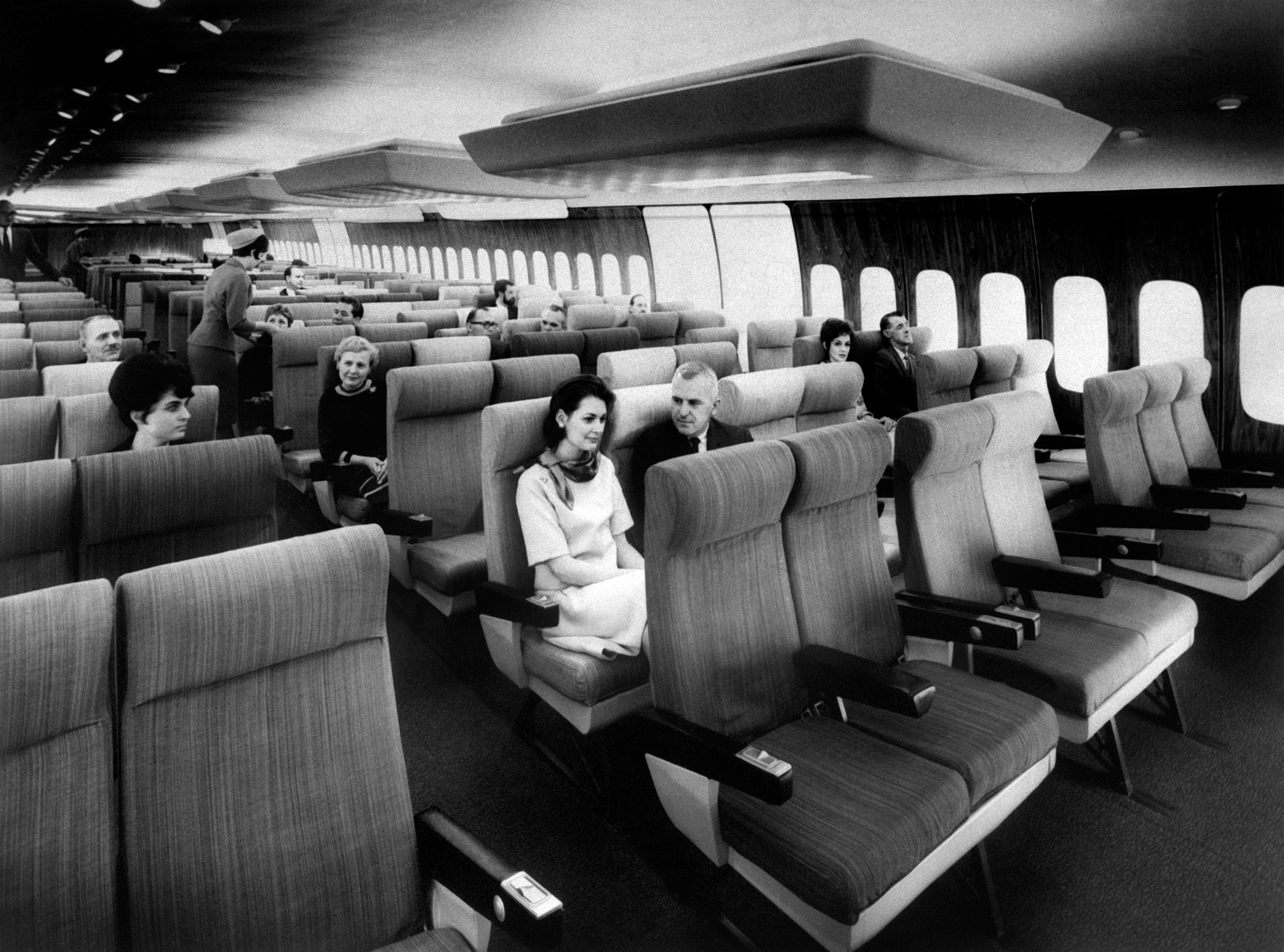
What's the biggest difference? No overhead bins! It looks positively roomy in there.
I wonder if the overhead bin model is really the best one -- it feels like a huge bottleneck. Reduces headspace, slows down load in and load out dramatically since it essentially requires that every passenger be able to military press a 20lb+ weight (or have someone else do it).
I'm not sure what a better plan would be though :) Maybe raise the cabin slightly and have the bins be built into the floors below each seat?
Hum, expert in here will correct me if I'm wrong, but, beside the bins, over the years, version after version, I feel that airframes actually slowly shrunk.
The original 747-100's engines were underpowered. That's whey there's extra space for the lounge and more space. As engine technology caught up the aircraft seating increased density.
Over the years, the airlines _have_ reduced seat pitch, and as you can see from the 747 illustration, added an additional seat in the middle section as well.
In recent history, Delta only flew 747s between 2009 and 2018 (they were originally Northwest planes, acquired in the merger). I can't find any evidence that any of them ever had 3-5-3 seating.
Such a shame. The best flight I ever took was on an A380. The thing was just so big that turbulence didn't seem to affect it.
Flying on the jumbo jets was always a trip. With Boeing pulling the plug on the 747, it will be long time before anyone makes a double decker again, if ever.
I'll never forget my first flight on a 747. DEN to LAX, and for some reason the plane was almost completely empty..maybe 20 passengers. I was way back and was able to absorb the view of almost the entire airframe from the inside. As we neared the end of the takeoff roll and the pilot started to rotate, the wingtips started to raise with the stress on the wings. I've seen this before in other planes of course, but the thing that was odd was that as this continued i could see the walls of the fuselage directly over the wings start to bow inward. Not by much of course, but it was incredibly obvious and interesting.
The next flight was from LAX to MEL and it was completely full. I never thought we were going to get into the air.
Even mostly full of passengers, you’ll notice short hops like DEN-LAX have noticeably shorter takeoffs. Weight of the fuel for a 747-400 when fully fueled for something like the ass-deadening LAX-MEL and LAX-SYD routes is something like 25% of the plane.
As I understand it, 4 engine planes are less economical and are now unnecessary due to the reliability of 2 engine planes. I could see the last 747s serving as great monuments purchased by Billionaires to add to their collections. No 737 Max is going to give you a spiral staircase. I can't help but see this as a problem though, as we converge on a single type of aircraft it moves more and more to winner take all for the design.
1) The variability of traffic leads to jumbos being underutilized, wasting fuel and capital tied up in such oversized planes, when it's better to have a 787 in use full time more consistently
2) Airlines got tired of having to maintain 4 engines when they could just have 2...
Other thing is that 787 and A320 can reliably fill up on "thinner" routes, which siphons off people who would otherwise change at a hub airport onto a jumbo, and filling jumbos was already tricky.
There is a reason the largest operators of A380s and 747s are the ones with absolutely massive hubs; either a legacy European flag carrier, a Middle Eastern mega-hub airline, or an airline handling large amounts of transfer volume from an out-of-the-way place like Australia.
Interesting. The 747 is certainly majestic and maybe even elegant. In contrast, many people hate the looks of the A380, but I quite like it. It's not sleek or pretty, but it's airplane-y. Look at the curved wings, the massive vertical fin. It's a huge, bulky, dare I say, voluptuous. Great plane.
This is really sad. I love both 747 and A380. To me it’s still more comfortable to be in the large plane for a long flight. 4 engines are better than 2.
Last fall I had the chance to fly SFO to LHR on an A380 and return trip on a 747. Such a smooth journey. Post COVID, I strongly suggest finding one of these for a future flight, if there are any left flying post COVID that is...
The fallacy of the A380 was the hub and spoke model.
Airbus thought people wanted to fly from a small airport to a central airport, to transfer to a A380, then fly to the other side of the world, then transfer to a smaller plane to get to their final airport.
Thus, your trip ended up becoming 3 possible transfers!
This is insane that I can’t imagine why the designers didn’t think this through.
And airports had to upgrade their facilities in order to handle the increased weight of the jumbo A380. This was a non-starter to begin with.
Boeing correctly realized that people want a direct point-to-point travel, with no transfers in between. Thus, they won out in the next generation airplanes.
But, whatever happened to those Dreamliners anyways? I don’t hear much about them anymore.
When many airports are restricted by the number or airplane movements (takeoffs and landings), then transporting more passengers requires bigger planes. It was not a stupid plan.
It works well for Emirates, Etihad, Turkish etc. - they fly from everywhere to Dubai, Abu Dhabi, Istanbul resp., and depending on the traffic in big or small planes. So you basically get anywhere with 2 hops.
most airlines use a combination of both models, but the hub and spoke model is more economical for the airline (apart from providing benefits for the customer). What does your data indicate?
They're still being made, they work great, etc. The biggest issue for Boeing is that they've hit really steep production costs on them. The idea is that the first planes start out really expensive to make, but you refine your methods as you continue manufacturing them, and eventually break even and start making a profit on each plane sometime in the future. It's taken Boeing much, much longer than expected to start making money on them.
And airport terminals simply didn't have the space for A380-sized passenger lists. I've been in many an A380 line where 3 or 4 lines across the entire walkway of the airport, blocking all foot traffic to other gates.
A couple of years ago, I made an international flight with my children. I made sure that one leg of the journey was business class on a 747 on the upper deck. I wanted my children to have had the memory of flying in the most iconic location (upper deck) of the most iconic passenger airplane in history.
If you can get a flight on the 747, I urge you if you are able to, pay the extra and get a seat on the upper deck. It will be one of those things you talk about for years.
United used to serve Melbourne by having one of the 747s from the LA/SF to Sydney services continue on to Melbourne. Last time I took it I was the only passenger upstairs on the Sydney→Melbourne leg. Coupled with the performance of a lightly loaded 747 that's only fueled for a ~400 mile flight (fastest I've ever had from takeoff to the 10,000 feet chimes), it was quite an experience (especially since being the only person there means your drink gets refilled rather quickly…)
Agreed. My first and only business class overseas flight was top deck on a United 747. An absolute joy. With a handful of passengers and your own crew, with the pilots up front, it feels like you are on a private jet. The cabin wasn't as nice as some of the newer business class offerings, but the experience made it so worthwhile.
I don't think it's that disappointing. The airlines moved from larger flights to more frequent flights between more destinations. These days, you can miss a transcontinental flight and only be an hour late to your destination, because there are 15 flights a day instead of 2. You are also likely to be able to fly non-stop between any two city pairs. (I looked some up at random, and you can do things like Montreal - Casablanca nonstop instead of Montreal-Toronto-LHR-Casablanca; probably cutting your door-to-door time in half.)
Losing Concorde was unfortunate, but there were just too many limitations to make it viable. Flying supersonic means you produce a shockwave that breaks stuff on the ground, limiting it to flying supersonic over oceans. Flying supersonic means that you have to produce kinetic energy that goes up like the square of your speed, meaning you need more fuel, and you need more fuel to carry the fuel. It barely worked for JFK-LHR (relatively short distance, mostly over the ocean), and there just weren't other routes where it was viable. With no viable routes, it wasn't going to sell in any volume, and there is some critical amount of volume you need to justify the program (some fixed human overhead for every airframe project; if you sell 10000 of them, that rounds to zero, if you sell only 20 of them, that rounds to a lot).
Might be pessimistic but I don't think we'll ever see a supersonic airliner again. The sonic boom kills them. Those people that want to drill tunnels through the earth to get better-than-great-circle distances might be the future. But I'll probably be dead before anyone gets funding to do that.
> Those people that want to drill tunnels through the earth to get better-than-great-circle distances might be the future.
Might also get a little warm and you'd fight a lot of pressure, since you'd need to dig down about 1/3rd of the distance you'd want to save (assuming my elementary geometry memories aren't failing me). So to save 600km distance, you'd have to go down to a max depth of almost 200km. For context, the deepest bore hole drilled to date seems to be about 12km deep. [0]
So technology would have to improve a lot before global warming or the next meteor get us all.
Stopped flying it? That sounds dire. Smaller planes, like the smaller airbuses, serve for 25-30 years, right, so why wouldn't the A380 serve them for longer?
The economics were already marginal. You basically _have_ to fill the aircraft to justify its significantly higher operating costs over large twinjets today (and the fact that no airline has many means you lose many economies of scale). In addition, many of Air France's were some of the earliest airframes constructed, some of them non-standard compared with later aircraft.
With COVID-19 and an expecting reduction in travel lasting a number of years, all airlines are downsizing. An aircraft that's already marginal makes a lot of sense to drop, even it means letting it go while young. They're effectively getting replaced by the A350-900s Air France has on order which are _vastly_ more fuel efficient per passenger.
There are several reasons. A big one is having four jet engines rather than two. If you had two equivalent aircraft but one a twin jet the other a quad, the twin would have higher efficiency. With each extra engine you pay for it with more drag and reduced overall efficiency.
The engines on the A380 aren't actually that modern with the two options being 15-20 year old designs. One of the reasons it was discontinued is that no engine manufacturer was willing to make new engines for it, so they weren't able to produce a modern fuel efficient variant.
And it also makes limited use of composites in its design, so it's heavier than it would be if designed today.
> A big one is having four jet engines rather than two. If you had two equivalent aircraft but one a twin jet the other a quad, the twin would have higher efficiency.
One can make a good case for turbine engines having better efficiency the larger they are (less losses due to boundary layer friction etc.), so yes, if you have two otherwise equivalent aircraft I'd assume fewer bigger engines would be better. But here we don't have equivalent aircraft, as the A380 is bigger than, well, pretty much any other passenger airliner out there.
The A380 engines produce around 350 kN, which is slightly bigger than, say, the B787 engines. Admittedly the A350 engines are a bit bigger than that, but not by a huge amount. But the data seems to suggest both the 787 and 350 are much more fuel efficient than the A380?
So to make an equivalent comparison, one would take an engine, make a twin engine plane and a quad engine plane with that exact same engine. Naively one could expect the quad version to take twice the number of passengers or cargo, and have roughly the same fuel economy/seat. If not, why not? Which scaling laws are non-linear here?
> The engines on the A380 aren't actually that modern with the two options being 15-20 year old designs. One of the reasons it was discontinued is that no engine manufacturer was willing to make new engines for it, so they weren't able to produce a modern fuel efficient variant.
> And it also makes limited use of composites in its design, so it's heavier than it would be if designed today.
This explanation I can certainly buy. Also that the biggest turbofans are nowadays so large that a twin engine plane is already so big there's a very small market for quads.
Some of the problems with the A380 come from the wing design: it has an unusually narrow wing for its weight (out of a desire to remain within the 80m box), along with the shaping of the wing being optimised for a heavier, long A380-900 that never came to market. An unusually large proportion of the drag comes from the wing on the A380.
It's worthwhile looking at where Airbus proposed to improve the A380:
* Densifying the main deck (going to 11-across in economy, still with 18" wide seats). This _alone_ in a typical configuration gives a 9% fuel-per-passenger gain.
* They looked at new engines (derived from the A350, for example) which would provide a 5% fuel burn gain.
* Minor wing modifications (new winglets and slightly reduced wing twist) which would provide a 4% fuel burn gain.
* Longer maintenance intervals (so the aircraft spends more time in the air earning money rather).
Other differences include that it holds much less freight in its belly than a 777 (a much larger proportion of its hold is consumed with passenger luggage), so you lose freight revenue.
It's also worthwhile pointing out that engines are some of the most expensive parts to maintain on an aircraft, so by doubling the number of engines on an aircraft you make a very significant increase on maintenance costs.
At the same time, you have the 777X lengthening the 777 (and increasing capacity) while reducing fuel-burn per seat, a much more versatile aircraft (an A380 will never be profitable on the major of 777X routes!), and more fleet commonality.
It's unclear what the situation for Emirates is. I would guess they're also hit by the drop in air traffic although they might be able to make the routes work with fewer people seeing how they have a lot of luxury offers.
According to the Figaro article, 8 of their 125 planes are still to be delivered. Maybe they could turn a profit by gaining a bigger share on their routes from other companies?
the 787 all-composite is very cool; it's just sad that it's too expensive to retool the rest of the product offerings.
And it's cool that Boeing figured out 20 yrs ago that point-to-point would kill hub-and-spoke (not least because it's a great way to fly) and very sad that Airbus wasted so much money and people's careers on an ego driven white elephant that Boeing already told them wasn't going to work, instead of using that money to push the real envelope.
The Concorde was done in by fuel prices, and because it was a small aircraft. I visited one in a museum and it was claustrophobic. Also nobody should be sorry that elites have to sit on long overseas flights just like we do.
The A380 was a boondoggle from the beginning, an attempt to outdo Boeing by having TEH BIGGEREST aircraft on the market. Having to rebuild airports to accommodate it wasn't a good idea.
The 747 is a 1960s design, for Pete's sake. How long were we planning on keeping it around?
The B52 first was first rolled out for production use on 18 March 1954. The "...long-rifle of the air age..." -- Nathan Twining. It has not been manufactured since 1962. They are still in active military service, the ones that remain, and continue to see upgrades and evolving mission scope. 100 years of service is feasible.
They also spend comparatively little time in the air. Compared with passenger aircraft where their return-on-investment strongly incentivises them being airborne as much as possible, military aircraft spend _a lot_ of time sitting around, either unused or in maintenance.
It's very easy to upgrade a strategic bomber. All strategic bombers are prone to interception so the only way to stand out is by having a bigger and modern payload. You can see the same development with tank cannons. Bigger calibers aren't necessary. The Rheinmetall 120mm cannon can be upgraded by simply shooting modern munition.
747 has been continually updated but the all modern airliners still have the same fundamental design.
> "Also nobody should be sorry that elites have to sit on long overseas flights just like we do."
Anyone can fly as long as they can pay for the ticket. First-class passengers subsidize economy seats for most flights, and new tech generally starts with wealthier early-adopters before it becomes accessible for everyone.
By the way, if you live in the West then you're an "elite" compared to billions. Let's drop the classism.
When I worked in aerospace I was told by a Boeing old-timer that he was sure Boeing only made the 747-700X proposal last as long as it did in order to force Airbus into making the A380 mistake, and that none of the Boeing insiders thought a plane that big would ever make real sense to spend money developing. Naturally I have no way to verify this, but it's a fun corporate strategy conspiracy theory.
I don't think there's any question that it was a response to the A380, and it's quite plausible they wouldn't have developed it without the A380. That said, compared with the A380 development the 747-8 will have been cheap to develop, and had an impact on the market as a whole even if it scarcely made much money.
It's pretty sad how Airbus defines themselves in comparison to Boeing, and Europeans define themselves in comparison to Americans in general. They don't have much identity of their own other than "screw you America! I'm the opposite of whatever you stand for!" It's so small-minded and petty, but unfortunately it's reality.
The major issue with the jumbo planes' (passenger) variants is that twin-engines now have significantly increased range, and have half the fuel consumption to boot. It's a lot easier to sell premium direct tickets rather than convince people to transfer onto a large cattle-class jumbo jet. Even pre-point to point, actually filling up a jumbo jet could be quite difficult, so now the death knell has been a long time coming, unless you're a Middle Eastern carrier operating the super-long-haul hub model.
> I visited one in a museum and it was claustrophobic.
I also got to do a walk through in the Air and Space Museum over a decade ago. It's deinitely a tight space amd the seats were tiny. I'm not terribly tall, about 6 feet, and I had to hunch over to avoid hitting my head.
The designers elevated the driver cabin so that it would be possible for passengers to walk underneath it when they coupled multiple trains together into a longer one. Sadly, it turned out the doors for the interlocking mechanism were very error prone so in the end they just welded them shut and you have to go around outside (at a station) if you want to move between trains sets.
There was also a telescoping gantry-like contraption that went across. I can see how that is quite fragile mechanically in a moving vehicle with vibrations and everything.
With more efficient engines on smaller planes, we can now fly nonstop transatlantic between city pairs that would never have been available before. Indianapolis to Paris for example. This is a net gain in my opinion over the big hub to hub planes.
Damage compared to what alternative? If I need to go somewhere as an individual, it's quite a bit more efficient to fly vs. driving. An Airbus A319Neo gets 122 mpg per seat. That's almost 5 times the 2017 average gas mileage for American cars. [2]
The current set were built in the 1980s, these ones will likely have a similar lifespan, so who knows? If you had to pick a non-747 Air Force One today it'd probably be a 777 or 787, although it'd be fun to see a C-5 in AF1 colors.
In 30 years the President may hop around in a custom SpaceX Starship.
> In 30 years the President may hop around in a custom SpaceX Starship.
This would be really cool, but it wouldn't work for the "last mile". It's too loud and obnoxious to land in cities.
Maybe if they could modify it to deploy Marine 1 mid-air, but to me that sounds a lot like stranding the president wherever you dropped him off and an necessarily high risk maneuver.
Maybe the president gets an ICBM-Force One in the future, but I bet they also keep an Air Force One equivalent around too.
Maybe... the Secret Service and Military REALLY want a 4 engine plane for AF1 -- remember other than transporting the President it serves as command and control for US armed forces. Losing an engine due to an attack is part of their planning.
They may look at a military conversion if there isn't a civilian airliner available.
Hmm, does 4 engines really add to survivability? Looking at recent-ish cases like the 777(?) the Russians shot down over Ukraine or the case in Iran a few years ago, after being hit they go down pretty solidly whether they have 2 or 20 engines.
I guess the one case where 4 engines might be useful is if somebody sneaks up with an IR-guided manpad near an airport. Such a small missile might just take out an engine without breaking up the entire plane.
Then again, in a war if you're operating AF1 anywhere close where hostile missiles are a concern, you're doing something wrong.
Yes, 777 (X or BJ) is also capable of the longest max range of any US jet, so I imagine that would factor into an AF1 decision too. Longest range or loiter time without refueling.
A friend of mine drives 747-8F freighters for United Parcel Service (UPS).
She trained for the -8F series upgrade at Anchorage. [Via @ethagknight comment](https://news.ycombinator.com/item?id=23718445) I learned that this is Ted Stevens Airport, a refueling stop for everybody doing air freight from Shenzhen to USA. Apparently they have lots of other operations there, makes sense.
I really like the 747-8I it is a pretty plane and actually also economic. Widebodys are more comfortable and the upper deck is just awesome. For those who wanna fly with the 747: Book a trip with Deutsche Lufthansa or Korean Air. They both use the newest type and probably will keep them flying for a long time. Passengers is what keep them in them flying :)
You're correct. I should have been specific. Between the two, are two engine aircraft or four engine aircraft responsible for more deaths? Normalized for number of aircraft/flights over a fixed time period.
Modern two engine aircraft are amazingly reliable, but there are rare cases where they have lost both engines. BA Flight 38 crash landed on approach to Heathrow due to ice in the fuel clogging heat exchangers for both engines.
Yes, but would more engines have helped in that case? If that problem stopped both engines, chances are the same problem would have stopped all 4 engines on a 4 engine plane as well.
So you'd need to look at cases where independent failures cause both engines on a twin engine plane to fail. I'd guess those are quite rare.
I'd guess you'll have such a small sample of engine related fatal crashes, that comparing the two numbers (per total persons flown) would be completely random result
Pretty good. I've been 'upgraded' a number of times on KL691/692 to and from Toronto when I ran a small multinational and shifted every week between Toronto and Amsterdam. The flight on a 747 compared to smaller planes is already much better, and on the upper deck the food; chair and room were several notches above anything else I've experienced on board of aircraft.
The 747 is humanity's greatest achievement. Air travel is the confluence of engineering, policy and governance (the heyday of the FAA/NTSB and how we got to the point where air travel is this safe), and the systems engineering that get aircraft, people, and baggage to so many different places. What the Boeing 747, and only the Boeing 747, has is true artistic value, with a profile evoking Botticelli or Rubens.
I agree that the 747 is a work of art and may represent the best we can accomplish in air travel (with regards to safety, reliability, and operating at scale) and reminds me of my favorite IdleWords article, "Web Design - The First 100 Years"[0] which talks about the unbounded optimism of the 1970s when moon vacations were still in the public imagination.
But the 747 was good enough and collectively we really didn't need to go supersonic or into orbit (or at least, most of the world couldn't afford it)
The article makes the pivot that web technology is no different -- that there might not be a supersonic quantum AI coming down the pipeline, that the tech we have now might be pretty much as good as it gets. Makes me feel less guilty about wanting to use old reliable tools and not follow the hype around smart contracts and adversarial agents. A relational database with some CGI scripts is going to be just as useful in 100 years as it is today.
That hump isn't just physically ugly, it's socially ugly as well. It is where the elites congregate. Anything that diminishes their status relative to our own is a good thing.
Though not originally. Upstairs used to be the first class lounge. Over time this generally under-utilized space got changed into business class seating.
(The lounge dates to before business class existed. That said, modern international business class is more comfortable in most ways than first class was at the time.)
The 737 is pretty versatile though. It's limitation is capacity and perhaps range. Range has been improved over the years allowing a lot of medium-range thin-capacity flights. The 737, 777 and 787 combined have eliminated the need for the 747, 757 and 767.
The classics have mostly or entirely been retired, with the most common models being the -700 and -800. The family has enough flexibility to evolve in range without needing a completely new family. The 737 still has its place as the short to medium haul work horse, so I don't see it going anywhere for a long time.
> The 737, 777 and 787 combined have eliminated the need for the 747, 757 and 767.
There are huge demand for A321LR precisely because there is a need for 757-like capacity and range. Granted, when 757 was discontinued the demand wasn't there yet.
I suppose I can still see a need for a 757 aircraft. My thinking was that our economy now requires so much travel that a 787 could be mostly filled. There are so many variants of the A320/321 that I can't even keep track.
Generally speaking, part of the point to point trend has also been to downsize planes, not only to serve thin markets but to provide higher frequencies so that passengers have choice of when to travel during the day. Plus there's money to be made with premiums on thin markets still, given that the matrix of East Coast - Europe flights is not anywhere close to being full.
The original "long" 737 variant was 30.5m; the 737 MAX 10 is 43.8m long. Many of the problems with the 737 airframe are rooted in this growth, along with it being originally designed as a regional jet with needed compromises (being low to ease airstairs, which caused problems with engines since the first re-engining with the Classic series).
Note that Boeing was trying to sell airlines on a clean-sheet aircraft when Airbus launched the A320neo, and _quickly_ started gaining customers, including those that had been loyal to Boeing for decades. Boeing needed something to counter the A320neo, hence the MAX had to happen—and soon.
Why do you think this? The 737 is the most popular airplane of all time, and airline orders are trending towards smaller planes. Airbus can't make enough A320NEOs to capitalize on the slowing orders from the MAX situation, and the MAX is still a very competitive product.
Aviation regulations are often written in blood, and while the MAX is obviously not in a great place, it's not necessarily doomed forever. Nobody thinks twice about the batteries on a 787 anymore, or the pylon assemblies on the DC10.
I would have thought they'd pull the plug on these new jets they had to fake safety compliance for and keep the older, working models that people will actually fly on.
I can't imagine anybody flying on a 737 Max even if the Boeing execs over at the FAA claim it's safe again.
Good riddance- with any luck the post COVID-19 world will be one with less reliance on air travel for the atmosphere's sake. Especially in the numbers that once made airplane designers believe the 747 and A380 could be economically viable.
Regardless of the plane size however, there's no getting around planes depositing pollution in the upper atmosphere is worse than we thought and cannot be thought of in the same way as emissions from a train or power plant: https://www.newscientist.com/article/2207886-it-turns-out-pl...
I believe the alternative to phasing out air travel isn't finding another mode of transport to replace it but instead asking whether or not in a world with teleconferencing and the internet if it's worth the damage to be physically moving people around.


This is imply not true. The last 747s built are freighters. Freight demand is at an all time high due to COVID and constraints on supply chians. Even passenger vehicles are being called into freight service (which is far less efficient yet still economical).