> I’ve seen generations grow up. Some grandparents come in with their grandkids and say, “Anna, remember the jukebox?”
    > Today, however, young people no longer come to the bar. They came when we had the dance floor and the music. Today, they like to spend time with the smartphone; they even take it to bed when they go to sleep.
What are we losing, what are we taking away from life, now that we ourselves have become a resource to extract. Probably, a lot.
> Today, [young people] like to spend time with the smartphone; they even take it to bed when they go to sleep.
Recently my parents (in their mid-60ies) were visiting us. At some point I realized that both of them had been quietly sitting at our dinner table for over on hour, eyes glued on their smartphones. They are massively addicted. I have noticed that they get nervous as soon as the smartphone is out of reach, or even in silent mode. They mostly talk to friends via Whatsapp and are in constant fear that they miss out on something or that these friends (which also seem to spend most of their days on Whatsapp) will be offended if they don't reply within 5 minutes to the latest Whatsapp trivia. It is quite a struggle to even get them to turn off their phones when we are having dinner. The Whatsapp messages just keep coming in. My wife recently learned that her mother mostly spends her evenings with posting photos of her life on social media, and broke off contact with her brothers for a few days because they failed to quickly and enthusiastically react to some photos she posted on a family Whatsapp group.
But I guess for Anna Possi, our parents are "young people" and could be her grandchildren...
I feel like she's comparing the young people she sees today with the young people she saw 20/30/40/50 years ago. Not today's young people with today's older people. As you point out - people in their 50's/60's tend to be addicted to their phones too and in my experience have even less etiquette when in public or company.
And it's probably notable bc youth is marked by the energy and spirit you have that becomes hard to maintain as your body grows old and weary. Old people swapped reading and knitting and cards and yapping for smartphones, while the youth swapped dancing and singing and meeting new people for smartphones.
I agree with you, the infection hit quite a lot of older people very hard as well. I have problem getting some 40somethings to meet in person, even in professional contexts, they are just so soaked in a WhatsApp maelström of utterly irrelevant messages that they are conditioned to answer NOW!
That said, the core of the message should not be judgments between the young and the old, but the problem that we have introduced digital fentanyl into our pockets.
You're right, as is your parent comment, in saying that this isn't something only the young suffer from. In fact it's everywhere; the people with the worst smartphone addictions near me personally are an 11 year old and a 70 year old...
That said the message, when taken as a general progression between how life was then and how it is now, stands.
The same thing happened with TV in the 80s/90s. It will eventually fix itself, Gen Alfa will grow tired of smartphones when they will be in their thirties, I'm pretty sure.
(that doesn't mean that there should not be active campaigning to point out the risks of smartphone addiction)
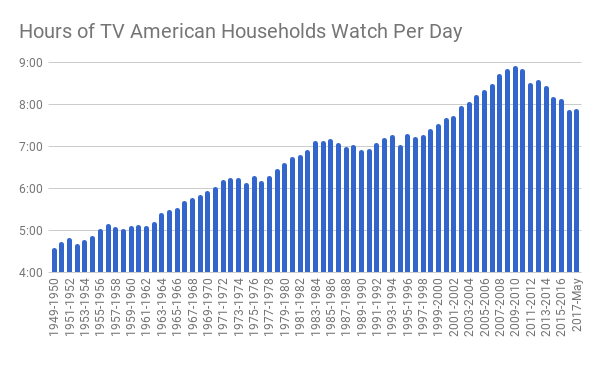
TV use was higher in the 2000s than it was in the 1980s/1990s. TV viewing hours steadily rose from 1949 until finally peaking in 2010.[1]
But when TV finally peaked in 2010, did overall screen time go down? No. It kept going up.[2] Obviously, this is when the masses went all-in on smartphones, social media, and the internet.
Screen usage basically never went down. It has only gone up.
So I only see anyone getting tired of smartphones and actually using them less if they've found something more addictive to replace them.
You have a good point I overlooked, thanks for the correction. I actually missed the "TV was just displaced" angle, which makes sense both statistically and anecdotally, if I think about family and friends.
TV also had a social aspect that internet does not have by construction: You had the same program on only a few TV channels and this was funneling people to talk about similar things or have discussions about the previous day show.
These things rarely happen organically anymore unless "forced" in one way or the other...
A friend of mine's kid (maybe 10 years ago) started crying when he watched regular TV for the first time. He literally thought the TV was broken when the commercials came on with the volume cranked up.
It's the same now with fb and these other old format social media sites. People just stop doing it. With that said I literally think fb will be with us for another 50 years as the people who are still on there are great marks and they won't be leaving until they 'age out'.
It seems we (America) are in some kind of “middle”, or at least a phase change in a larger wave of the addiction cycle, with different stages affecting different generations and countries based on arrival of what can be described as the addiction dealers, “Big American social media”. It reminds me of the effects of the crack epidemic rippling through different generations differently from the late 70s to this very day still.
I don’t have hard data to substantiate it and my theory is based on anecdotal conversations but it seems, e.g., where there is some recovery going on amidst something like American millennials, who have both dealt with their own addiction and were the first generation that is also dealing with the neglect of addicted parents, they are also to some degree recovering (“reparenting” themselves), to some degree probably also spurred on by realizations shot the deleterious effects of phones and SM that come from exhaustion and different life stages. On the other hand, other generations of Americans, like those now elderly parents of millennials, not only are still, but increasing number of them are entering the earlier stages of “phone addiction” (which encompasses many different things), with the most tragic part being that they are in the latter quarter of their life and are unlikely to even realize, let alone recover from the addiction.
I also see this cycle and these stages emerging in other western societies in particular. My theory is that it is a particular effect or amplifier of the underlying culture to some degree, i.e., adoption, degree, impacts. It seems particularly pernicious in America because the underlying culture (if you can call it that, after decades of it being poisoned and corrupted by corporations and the government) was and is fertile ground for the societal rot caused by social media and its amplifier, smart phones, to have taken hold and spread like the virus it is.
It was even all described as “viral”, and yet we still engaged in it as if unfamiliar and investigated viruses spreading in an uncontrolled manner are a perfectly acceptable thing that should not even give anyone pause, especially if money can be made, regardless of whether it is something like HIV, with a very long lead-time, a delayed ETA for the reaper.
What happens now that we are in some kind of middle stage of the “smartphone“/Social Media civilization wildfire, with the first to have been affected looking over the devastation it has left in their wake, Shell shocked by the neglect and destruction, as the inferno is still raging on off in the distance as it consumes their parents and new generations, and even toppling whole countries through the “Color Revolution” playbook?
English has ae in Maelstrom but the contemporary word in Danish, Swedish and Norwegian is Malstrøm/Malström. I wonder when it lost it's ae, I see Mahlströmn from 1698, reading the etymology it says dutch but I wonder if they just wrote it down first. Everything about the sea is always filled with mythology.
I think social media needs a less poetic word though.
I would say that the ae comes from Dutch, it was the way the open a sound used to be spelled before it became aa (maalstroom). You can still see it in place names (Aerdenhout which is pronounced Aardenhout).
It never had the ae in swedish and danish. Its from male/mala, to grind or to mill. English somehow changed it to ae, maybe through dutch where its maalstroom.
The OED agrees about the Dutch idea, giving the etymology as:
"early modern Dutch maelstrom (now maalstroom) whirlpool < malen to grind, to whirl round (compare meal n.1) + stroom stream n"
and also thinks Dutch is the origin, with Swedish/Danish etc taking it from Dutch too:
"The use of maelstrom as a proper name (also in French) seems to come from Dutch maps, e.g. that in Mercator's Atlas (1595). There is little doubt that the word is native to Dutch (compare synonymous German regional (Low German) Maling). It is true that it is found in all the modern Scandinavian languages as a common noun, but in them it is purely literary, and likely to have been adopted from Dutch."
Yes, it seems to be everywhere. Like an epidemic. When I pick up my daughter from school, I have to wait outside the entrance for about 10 minutes with other adult parents. Nine out of ten parents just stare at their smartphones and don't even look at me. In the past, people would have started a conversation out of boredom and gotten to know each other. We are really losing so much.
In the context of the above posts, which is young people eschewing dancing in favor of using smartphones, old is an adult that is expected to behave at or near peak maturity compared to a younger person whose is just coming into their own (presumably 20s).
My parents were like that, in a different way. They couldn’t sit in a room without a tv on, even if they had visitors and everyone was talking and not paying attention to the TV. Living room TV was on at least 16 hours a day, just about every day, I bet. So weird. Also had TVs in every bedroom, including rarely-used spare bedrooms. Like they had six TVs in their house at peak. WTF.
(Actually, my in-laws also do the TV thing, or else a laptop playing YouTube trash… plus phones)
I have recently moved into a new accomodation, and my neighbour is an elderly Italian lady in her mid 80s. Our first conversation was about how estranged she feels nowadays that everyone around her, young people but also middle-aged adults, are unable to connect not only with strangers but also among each other, filling every minute of their lives with a smartphone. Even the doctor's waiting room or Sunday mass doesn't feel the same, and she has to force people to snap out of it and just put the bloody phone down. She asked me how did I cope. I said I didn't, really.
We had a beautiful conversation about that as it is a topic that I think about a lot, yet whenever I breach it with any "adult" (millennial or older) the response I get is either a shrug, or denial. Weirdly enough, it is an easier topic to discuss with the younger generations, those that have grown up in the YouTube era, yet deep inside feel there is something crucial that's gone lost in our society and we haven't even started trying to recapture it.
I have always believed the millennial generation to be the only one to do something about it, as it sits right between the major societal upheaval the internet has brought. The older generations are lost to Facebook and inertia, the younger have never even seen the world of before.
When ever in the history of the world were humans not exploited by other humans, in much worse ways than now? I'd rather be google's data source for ads than be someones actual slave for example.
Also I don't really like these luddite sentiments, usually shared between the two extremes, old ladies that never used the internet so they don't understand what they are missing, and IT guys that are too jaded to see the benefits and are at the stage of "wanna become goat farmer". Outside addiction the internet is great.
Some argue you're still one, they give you just enough crumbs so that you shut your mouth and bow your head while you work from birth to death, being taxed every step of the way, with more and more limited privacy and liberties. Meanwhile the top 1% still live like kings, laws barely apply to them, they're in charge of everything even though most of them haven't been elected
I would guess an actual slave would find that comparison horribly offensive. And kings were born into their position, but there is quite a bit of churn in leadership during my lifetime, so I struggle to see that equivalence either.
You can compare anything. Being outraged at comparisons is the most basic reply to anything. You thinking something isn't comparable to something else is in itself a comparison. At least make an argument.
..."It is exploitation but at least it is not slavery" is a (let me put it frankly for you seen as you need it) shit argument that justifies and proves nothing.
To expand, I wonder whether people will wistfully look back on their days browsing tiktok and shitposting on HN compared to whatever they and their kids / parents will be doing in 20 years.
"now that we ourselves have become a resource to extract"
I take your general point, but I'm interested in what you mean by "we" here - the general population or HN readers? People have been a resource to extract from since the beginning of farming, and particularly so since the beginning of the industrial revolution. The difference is perhaps that the attention of rich, western people is being exploited now and is causing this particular concern. Read any first-person accounts of the industrial revolution and the idea that this is anything new falls apart.
> now that we ourselves have become a resource to extract.
This has nothing to do with what you quoted.
Smartphones and their effects are orthogonal to your point. Before smartphones if you were at home you were alone, isolated, and bored, so you went out and met your friends. With smartphones you are always connected to your friends or others and it seems that it reduces the psychological need to meet in person (it's no longer the only option).
That's overly simplistic, people don't go out because they slack 24/7 in front of a screen, not because they're connecting with their friends through their smartphones. From my limited experience 70+ years old spend the whole day in front of youtube/facebook/alternative tv channels mostly watching infotainment that's at best brainrot and very often full blown conspiracy theories / propaganda. Boomers are even worse than teenagers when it comes to that, they're the most gullible and easily screen addicted demographic out there
The simplistic and beside the point claim is that this is all "we ourselves have become a resource to extract". This is both not new and not key, and more of a political rant.
Before smartphone there was TV and cable TV. Young people spent time in front of the TV but TV is passive and does not allow you to connect with others.
Old people spent their time in front of the TV, before that they spent time by the radio, etc.
The youngest boomers are in their 60s now (and people in their 70s are boomers) so not sure if your really mean "boomers"...
What is the relation between all that and "now that we ourselves have become a resource to extract" in relation to smartphone use and changing socialising habits? This is a very shallow and short-term view. People like scapegoats and shallow reasoning.
Ubiquitous smartphones are a fundamental shift irrespective of the big bad capitalists who are doing nothing new.
Perhaps we could add parenting. If parents let their children hold on to their smartphones 24/7 it's no-one else's fault. In general, at least in my case and my friends', TV was highly "regulated" at home.
Went to Japan recently and the young women take social media (particularly Instagram) to a whole nother level over there. They very clearly invest a lot of time and energy into getting the best photos. A lot of the young men just look defeated.
I always find this argument dubious at best. It's akin to saying "A dude was wrong once 2000 years ago, anything new is progress, and progress is desirable".
Maybe we are talking about the same thing, but my intent was to say that original quote was in the theme of "kids these days...".
Not all progress is desirable, of course, and smartphones have their own problems, but same was told about younger generations and internet, TV, newspapers, etc. But those generations grew up out of it and personally I'd argue that smartphone addiction is not only young people problem.
Socrates said no such thing, no writing of Socrates has survived. He was just a character is Plato's book, Phaedrus.
Please do find the original paragraphs before accusing Socrates of this. https://standardebooks.org/ebooks/plato/dialogues/benjamin-j...
Of course, you can read and interpret that same book a thousand different ways, like he was talking about knowledge not being the same as writing things down, or whatever you want. But we don't even pretend to read the things we talk about. We just repeat nice narratives we have supposedly read somewhere else, digested by someone else, somehow.
And he would've been right. Any new advancement in technology brings societal change, and it is possible to reach a point of diminishing return, where the bad sides outweigh the positives.
I wish we could, as a society, have a serious conversation about this effect without resorting to name calling ("Luddist nonsense") and straw men ("but what about penicillin?")
Second that. I see that as a failure of society or democracy as a whole - that we are no longer able to have that broad, public conversation and act accordingly. Why should every "innovation" be shoved down our throats, if we don't want to?
I would place this blame on academia. They're the ones that are supposed to think difficult questions, and drive change. I guess today any serious discussion would just get lost in the ocean that is the Internet. Only echo chambers get reinforced.
Blaming academia is misguided, and "drive change" has never been in their job description until Progressivism took hold. The problem is each one of us: we want to numb out more than we want to do something hard. The problem is also philosophical/religious: we have collectively decided that virtue is following our animal desires (what makes you happy), which is the opposite of historical virtue. I think this can be traced back to the prevailing nominalist utilitarian view: matter is just what we make of it, and since there is nothing higher than matter, the only ethic is greatest happiness. So now, as a society, we do not really have any way to articulate the problem we intuitively feel, because the problem is that our underlying philosophy does not work, but we have even forgotten (societally) the other philosophy that has historically worked, so we cannot easily get back. I think this accounts for the interest in Stocism and traditional Christianity (especially Eastern Orthodoxy), since both unequivocally say that being enslaved to your passions (animal desires) is not the good life.
Huh. I blame it on the influence of money. Money flows easier when hysteria (really any level of un-rationalized fear) and its peers abound. It is hard to have honest rational objective discussions these days without the influences of earning another buck being just over the cognitive horizon.
The real explanation is that you cannot find new sex partners in bars anymore. If there's no sex, there's no reason for any kind of social life, human relations, romance, etc. anymore.
It used to be hushed because people thought nothing can keep young people away from each others bodies anyway. However, now it's apparently happened - social media, woke culture, fight for jobs...
People think it is smartphones and social skills. The real reason is men are blackpilled and stopped trying. What we are seeing is only the beginning.
She's vividly awaken with an active mind at 101 yo, it's not a thing for everyone. We try to fix the body decadence problem with technology while ancient seems already discovered it. You can see it in her words and her lifestyle; a simple life, a helpful work, a community that makes you feel appreciated for what you do. All the rest doesn't really matter for longevity.
Btw, the woman is addressing the interviewer using "her", which is a common form of respect, for a person probably half her age.
many people living simple fulfilling lives die much earlier, it's more an exception than the rule (I don't argue that those things doesn't help, just that they alone is not the reason for long healthy life)
I have a pet theory that classical musicians overindex on longevity, and I believe that the fulfilment and community aspects are contributors to their longevity.
No evidence and probably full of bias but seems intuitive enough
I think in her case, she kept working, kept interacting with people on a daily basis. A lot of elderly people see mental / physical decline in part due to inactivity, and doing your daily crosswords or brain trainer isn't enough I think.
I was thinking about robotic baristas the other day and how you might save on costs but you give up so much; If I’m going out for coffee I prefer places where I know the baristas so I get to feel like a part of my community.
There are a couple stores around me run by small families, and honestly sometimes I feel like I'm halfway to being part of their family when I visit. They recognize me, greet me by name, and start firing up my order right away. Or they ask me how I'm doing and I do the same, but it goes deeper than "good, you?" - I'm learning currently about how one dude is trying a year living together with his ex again. I'm praying for 'em every day pretty much. We share recipes, stores, etc.
We will rue every decision we make to remove humans from interactions imo.
I've started regularly visiting a couple coffee shops in Tokyo whenever I go there and I'm on first name basis with the owners/managers, whereas if I go to the same shops in the SF Bay Area more regularly it's rare that anyone recognizes me.
I definitely prefer that neighborhood coffee shop feel and at least shops I go to near home don't have that. Even the smaller ones with similar amounts of business and number of employees as the ones in Tokyo.
Coffee vending machines? That’s what’s inside the box, it’s nothing new really… There are very high quality ones too. It’s not a particularly skilled job for a human to do, besides the customer service aspect of course, perhaps I am ignorant in that regard.
Indeed, coming from Spain, I don’t really see the lady as a barista, she is the classic bartender that listens to you and knows everybody. Except the bar is open throughout the day, is family friendly, sells all kinds besides alcohol (breakfast, coffee, tobacco, lunch, dinner, newspapers, lottery tickets, snacks and sweets…), and generally acts as the social nexus of the neighborhood. These old school small bars are everywhere in southern EU. Within that context it is less surprising that she would stay working there as long as she physically could.
I am also Spanish, living in Japan, and our bars is one the things I miss the most. Seriously, you don't realize how amazing Spanish bars are until you don't have them.
Here I just stop by a konbini, grab a can coffee and a plastic-wrapped sandwich, and off I go. There is no social nexus, and no neighbourhood for that matter. It's depressing.
When I was teaching in Ube, Japan in 1979, there was a great jazz music coffee bar. The entire wall behind the counter was covered with jazz LP's. They had huge speakers, a massive turntable, and a McIntosh amp. You would go in, pick an album and order coffee. The counter was lined with vacuum coffee makers. The barista would grind your choice of bean and fire up the coffee alembic. The boiling water would erupt into the upper chamber, brew a while, then magically get sucked down into the bottom carafe when he took it off the flame. You could drink at the counter or go to a table. I didn't look like a beatnik, but I felt like one! Cool, daddio.
Izakaya usually only open for dinner, maybe lunch, but definitely not breakfast. Many of them also offer private rooms, which is the complete opposite of the social aspect of Spanish bars...
> Coffee vending machines? That’s what’s inside the box, it’s nothing new really… There are very high quality ones too.
I have yet to see a high-quality one.
I've been at two offices that have automated espresso machines. They'll make something that's labeled as a "Latte", but it's just coffee with powdered milk.
You are right that most are not very good, but it's more because of business reasons than technical ones. It's more costly and bulky to keep remote coffee machines supplied with fresh milk or cream, as well as other extras, and keep it all well refrigerated. Most people do not seem to be ready to pay extra for it.
But a robot barista in a coffee shop would end up being exactly like normal coffee machines that have been around forever, perhaps just a bit higher-end than an office one. It's not really an idea like OP was implying.
I've had a coffee from a high end bean to cup machines, installed in a conference room at our vebdor's headquarters, which used fresh milk and made a better cappuccino than I've had from real humans at many chain coffee shops. They might be rare, but they're out there.
I feel like there are definitely two types of people that are after coffee - the morning commute people that need caffeine, and just want it fast. They'd not notice a machine doing it for them (and a lot of them would have a machine at home!)
The other group is like you and I, where we like engaging with the community.
I suppose three - the Starbucks crew that do it for 'likes'.
The Italian morning caffè ritual is already extremely fast: the barista works at the speed of light and the coffee you get is pretty standard, but in exchange you get a moment to rub shoulders "al banco" with others like you about to go into work, or elders just getting out of the house, a mother taking her kid to school, a policeman taking a break. You say hi to the same few people you've been seeing at the establishment for years. It's familiar and heartwarming.
It's a sprinkling of human connection as you start your day. A small homage to the tradition of coffee culture. Your grandparents did it, your parents did it, you did it, your kids will do it, etc. You rejoice in knowing that, as everything else changes around you, maybe this one minuscule secular ritual will stand the test of time and provide a symbolic sense of continuity with the past.
The wonderful feeling of walking into YOUR café, giving that special look to the barista, a smile, and he darts off at 100 km/h to make YOUR coffee (long, short, espresso, mochaccino) while he was already making a thousand others. In 3 seconds he already has YOUR favorite croissant in his hand, the water. “The usual?” You nod, smiling. A greeting glance to the regulars “of your hour.” Breakfast, you pay, you smile.
If you have two minutes, you skim the newspaper while eating your croissant, because that’s just what you do, even if you already skimmed the news in a rush on the toilet on your phone.
It’s a happy and friendly way to start the active part of the day.
To feel like you’re part of your community.
I love it — no vending machine or Starbucks can ever match it.
Despite worries about creeping prices, coffee in Italy averages around €1.20 for an espresso or €1.50 for a cappuccino [1]. Way different than in a major American city.
I think group 3 is a bit of a reach. Most people just treat it as a commodity. You need a break after shopping? Coffee. Meeting someone to talk over something for 30 minutes? Coffee. Need a cozy place to sit and get some work done? Coffee. For none of these do people have to engage with the community or be caffeine addicts.
I have a feeling that most people imagine this. But this doesn’t sound like on the ground reality for me? Here in Tokyo, most people I’ve seen just grab brewed coffee or the usual espresso drinks and go on with their lives. When I lives in Toronto/Vancouver, that’s what I experienced over there as well. Used to frequent one down the street as it was the cheapest brewed available coffee, and the regulars would always order their normal cups to go.
It’s interesting to see these type of generalizations that I never experience in life. I’m not saying there’s no truth to it, as girls in my circles often talk about “oh, it’s PSL season, I wanna go!”. But it’s hard to believe that all of their customers go for the special drinks.
I've never seen this either. I'm just interpreting what I think OP meant.
I used to live in Seoul, and new special food or drink items definitely would cause fad waves and would appear on Instagram feeds (Seoul is notorious for this), but I doubt it was the major parts of Starbucks' business.
The sweet latte-based drinks are a huge part of Starbuck’s business. They make far more money on these things (and frappucinos and iced lattes, etc.) than coffee or espresso. But it’s mostly just selling them to people who like the taste (and don’t really care for plain coffee at all). The people posing for instagram are a small minority.
Yeah most chains these days have specialty items that are 3 times the price of their staple items where they make a lot of money and draw in new and old customers. I think Starbucks was just one of the first to do it so regularly.
Robotic baristas - I'm assuming the OP is referring to those 6dof robot arm deployments - are largely novelty or luxury items meant to catch attention. You either see them in touristy areas trying to attract the Instagram crowd, or (increasingly now, after the novelty is starting to wear of) in corporate lobbies trying to impress.
> I was thinking about robotic baristas the other day and how you might save on costs but you give up so much...
How do they save costs?
Their operating cost doesn't beat gas station coffee, and the margins needed to service them end up pricing them the same as human barista coffee.
Automation only works if it helps reduce your COGS, not increase it, and for a product like coffee with already paper thin margins, the cost of servicing a robotic barista ends up not being much different from hiring 2-3 part time baristas while providing a subpar product.
I used to feel the same way, but, then I find it weird that the barista has to be there. I get the sense that some people use them almost like a free therapist since they have a captive audience.
It's an interesting sidebar discussion what are cultural norms on social interaction vs using someone like a free therapist. I guess consent to whatever topic, equal airtime, not saying inappropriate things, not slowing down their work.
Those already exist though, coffee machines have been around for decades. Granted, most of them won't make you a neat milk leaf or tree or whatever, but how important is that to you?
I have a feeling she would have said that 10, 20, 30, and 40 years ago, too.
But she's probably not wrong. Over the course of her life, the US has gone from mostly farm communities which for good or bad have long-standing social networks, to mostly atomized people in cities. We've also gotten incredibly richer as a society, but we don't know each other. If you don't know each other, who can you rely on? I assume that something similar applies to Italy.
Russia seems poised to invade Europe in the near future. If they do, and succeed, Rome could become part of the new Soviet Union(which Putin has explicitly said he wants to bring back)
Once that happens, it's likely to lead to poverty. At least that's what happened in the last USSR
>Russia seems poised to invade Europe in the near future
only if the near future includes the year 2150 because as of right now the Russian defense ministry is celebrating the liberation of individual bakery plants on their state media
Russia is neither poor nor failing, and saying that is underestimating the real actual danger they present.
Russia has vast natural resources and enough buyers for those resources even if the EU manages to completely stop (at significant cost). Their industry turned to wartime mode, resulting in the fact that they now have more armored vehicles than in February 2022.
Will they actually physically reach Italy? Probably not. Will they try to buy it out and bring a (even more) fascist autocratic regime there? Probably yes.
It's both poor, failing and with a population affected by chronic depression. But for that reason (desperation) they should not be underestimated and should have been handled in a way less gentle way.
> Russia has vast natural resources and enough buyers
Not saying that it's not what has kept them standing until now, but the buyers make the price in this case. So who knows what the price could become in the future.
> Will they try to buy it out and bring a (even more) fascist autocratic regime there? Probably yes.
Are you still talking about Russia with their monopoly currency? "Try" as in one probability over one billion to succeed and be disposed of a few days later. This ability to influence foreign countries effectively and not in clownish ways is a nice story for kids.
Let's entertain that idea. Suppose they did invade most of Europe.
How would they keep everyone under control? You won't find that many people eager to participate in satellite regimes or new social experiments, like you had in post-WWII.
I don't think Russia will even consider invading western Ukraine. They'll keep the Russian speaking part which they can easily govern.
> How would they keep everyone under control? You won't find that many people eager to participate in satellite regimes or new social experiments, like you had in post-WWII.
Through cynicism and propaganda, just like they've been doing at home, and the same way it works in the US now. Everyone can see the corruption and depravity of the current regime, it might as well be a Russian satellite (many people would claim it already is), and yet we all collectively do nothing about it.
Russia’s kleptocracy has impoverished the country so much that it now needs attrition in its male population to keep people from rising up against the current leadership. War is how you keep poor citizens from rebelling against you. When the war is over, historically the returning soldiers (especially in Russia) overturn the leadership. So there is never an incentive to stop a war. Especially a losing one.
The fact that it's a fragile kleptocracy basically reduce to 0 any possibility of a normal future. Puppet state at best, if someone is willing to take them. I expect they already planned what to do with the returning soldiers, not that they will like it or accept gracefully what's in store for them.
Those cover Russia's motivation, which is indeed strong. You can add that Putin wants the glorious Soviet Empire days back, and that without additional buffer zones Russia is very vulnerable to land invasion (in Summer). Russia has plenty of reasons to conquer much of Europe
But I don't see Russia's capability to do so. Their kleptocracy has impoverished the country and has repeatedly lead leadership (including Putin) to overestimate their own capabilities. Male population faces attrition from war and alcoholism. Leadership has a habit of dying in mysterious accidents or falling out of windows, reducing the amount of experienced leaders available and discouraging anyone with a brain from rising up too far. And they are barely able to advance in Ukraine.
There are legitimate concerns that Russia might attack other countries once the Ukraine war concludes. They might even make some initial territorial gains because they are in full war economy while Europe has only scaled up enough to support Ukraine, and has depleted ammunition stockpiles. But I don't see them getting very far
Yes, this was in fact an explanation of a joke. "In Soviet Russia, Rome is a poor city" requires both a currently-existing Soviet Russia, and Rome to be a part of it. Both of those are far-fetched. "Russia seems poised to invade Europe in the near future" is a bad explanation, since they are currently invading a country geographically in Europe.
Why wouldn't it happen? America's new direction is that Europe is the enemy, and massive resources will be poured into propelling the already popular right wing parties, which are Russian puppets, into power. They don't need boots on the ground to conquer the continent, they just need a cynical population that doesn't see the difference between good and bad, just like in the US.
I talked with a barista that had worked 10 years at Starbucks and he still made minimum wage after all that time, it was specially worrying since minimum wage in this country it's equivalent to 420 usd a month.
If you are in the US, you also have to incorporate the employer paid benefits in compensation, the big one being health insurance premiums/deductible/out of pocket maximum/provider network size (the premium is easily referred to by looking at W-2 box 12 code DD).
There are also other considerations such as PTO, 401k match, HSA match, DCFSA match, yadda yadda, so the only way to keep up with the market is to always be interviewing and evaluating new offers to compare your current compensation to.
I’ve done this as well. I’m only making twice what I was 30 years ago at 18. (Though to be fair, I was making a ridiculous amount of money for a 18 year old - my first job was in the Qwest network operations center.)
If they worked for a decade and never got a pay rise (other than minimum wage increases), why are they still working there? In an ideal world, you get wage and career progression over time, or move on to a different career otherwise.
Folks rarely have this choice. What industry wants a barista outside food service? This is why we get stuck wearing a green apron for a decade, or working call center jobs, or any other crappy job.
People aren’t locked into being baristas. People immigrate from all over the world to the US, and become whatever they have to. Dry cleaners, landscapers, cooks, maids, nurses, etc.
I always think that I would hate to work into my old age, but it's different for some. I can't speak to what Anna's financial situation is like, but the way she talks about her work as part of the community and a way to stay active and independent makes me think that she's content, and that's great. She certainly seems like she's doing well for 101!
I have an uncle that is extremely old and until a year and a half ago he was still working. But he needed a car for his job and he decided that he's going to get rid of the car before he ends someone else's life and so he had to give up his job too. He's a super nice character, has a great sense of humor and in general is probably one of the most fun and optimistic people that I know. He'd be working still if not for the car and I know that the loss of the job and a chunk of his independence is hard for him. But he does not let it get him down for long, just finds new things to do (he's currently studying bridge like his life depends on it).
It's the same reason you see barbers working well into their 70s.
After a lifetime offering a service to your neighbourhood, cutting hair and having a chat, why would you even retire? Just to stare at a wall, useless and lonely?
There was a barber down the street from my former work place, and I had no idea what his hours were. He seemed to just show up and work when he felt like it. Clearly was semi-retired.
Was a great story teller and joke teller. That was worth the price of a haircut by itself.
I can’t imagine I’d ever stop programming as long as I’m mentally and physically capable of it. That doesn’t mean I’d work until I drop, because I can always do hobby projects for myself instead. Being a hobby barista probably doesn’t work quite the same way.
For most people, it proves very disorienting to not be doing something constructive for others, and in a capitalist world, where everything easily becomes transactional and people get a little isolated from deeper community and family, it's kind of organic for that drive to be fulfilled by continuing to work in old age. Lots of people do it by choice.
If you feel like you might be on that road, the smart trick is to start thinking early about what kind of work you might want to take up during that stage and plant the seeds for it early.
Some people don't have a lot of choice to prepare, and just end up falling into being barista because the job is there and they find they enjoy it. But the other barista at that same cafe might be the owner who bought it as their own "retirement", filling shifts when they want to, while giving the neighborhood a place to gather.
Not every culture or community is built so centrally around atomization and transactionality as the prevailing one is. But those things represent the essence of what capitalism is, and are central to what it aspires to acheive. It works its magic when people can negotiate their relationships through currency and through accounts measured against it, and so a society that means to participate in it is one that tends to engender payment, quantified barter, and unburdened individuality over alternatives like filial concern or community enrichment.
It's not really a controversial thing to suggest, and wasn't there to be accusatory or something. It's the world we live in.
Not only is not controversial but one of the bases of Marxist critique of capitalism is the concept of alienation, which not even the staunchest defenders of capitalism deny.
If the pensions in Italy are anything like in Spain, she’s making more money off it than young people are making working. Plus she’s probably defrauding the pension system by both collecting her pension and working.
A defined benefit pension (or any other retiree benefit such as healthcare) is a claim on future productivity.
“Contributing” cash to it may not be enough, if the cash didn’t convert into sufficient automation to offset declines in humans due to declining birthrates.
So the question gets more interesting if it’s “Was contributing whatever amount calculated (using tenuous assumptions) many decades ago enough, especially if you chose not to have well raised kids who in turn could provide society with the retiree benefits?”
And then that opens up a can of worms about who was and was not expected to have well raised kids, and it gets messy very quickly, yet at the same time, we see a clear macro problem of taking more and more from a smaller young population and giving it to a bigger and bigger old population.
You are saying that very matter-of-factly, while that is not how it works here in the Netherlands, and probably also in other places in Europe. The reasoning being, the pension isn't an unemployment benefit, pension is a fund you spent your career investing into.
Working past a 100 is a dream of mine (The barista in the article is 101). I don't think too many people are fond of images of old age in the Western popular zeitgeist - care homes, infirmity, increasing disability.
I hope we can cultivate more 'blue zones' across the Planet, such as in Japan and around the Mediterranean. We have the capability to do so.
Personally, if I could stop working tomorrow I would. I have nothing against work, but I do feel that most jobs aren't particularly meaningful, and so they act as a pacifier that fills in our time so we don't need to confront the question of: what do we do with our time?
> I think if I could afford to retire tomorrow, I'd have no trouble keeping myself busy for the rest of my life.
Completely agreed. I took 6 weeks off between jobs a couple years ago, the longest continuous span without work or school since I was 14. It seemed crazy long. My goal was to get bored so I'd be ready to go back to having a job at the end of it. I completely failed, I filled those 6 weeks and would eagerly have filled many more self-directed months. Maybe it'll be different when I'm older but right now, I could easily spend years and years keeping myself busy if I didn't have like bills and stuff to pay.
> but I do feel that most jobs aren't particularly meaningful, and so they act as a pacifier that fills in our time
For like 99% of people, work exists so they can buy a food and a roof over their head.
> the question of: what do we do with our time?
I've got a growing Steam library of games that I've bought but haven't gotten around to playing.
It always surprises me when people complain about being bored after retirement. If you've got disabilities or fading health so don't have the energy or ability to do the things you want, that's understandable. But I'll never understand the people that are able-bodied yet get bored only months into retirement. I just think...what did you do during your free time before you retired? Just stare at the TV?
Covid showed me that the daily ritual of getting up at the same time, getting dressed in proper clothes, and taking a train somewhere all massively helped my mood and level of willingness to engage with life.
I can see how, in the absence of responsibilities, it's easy to slowly slide into a rut and become a depressed lump of a human that doesn't want to do anything. I also see that as part of the challenge: how do I stay disciplined enough to be happy, without being dependent on a job to force me out of bed?
She reminds me of the old people managing their crumbling shops in Japan that are popular on youtube. Being still able to work is nice, as long as you are not forced to just to survive.